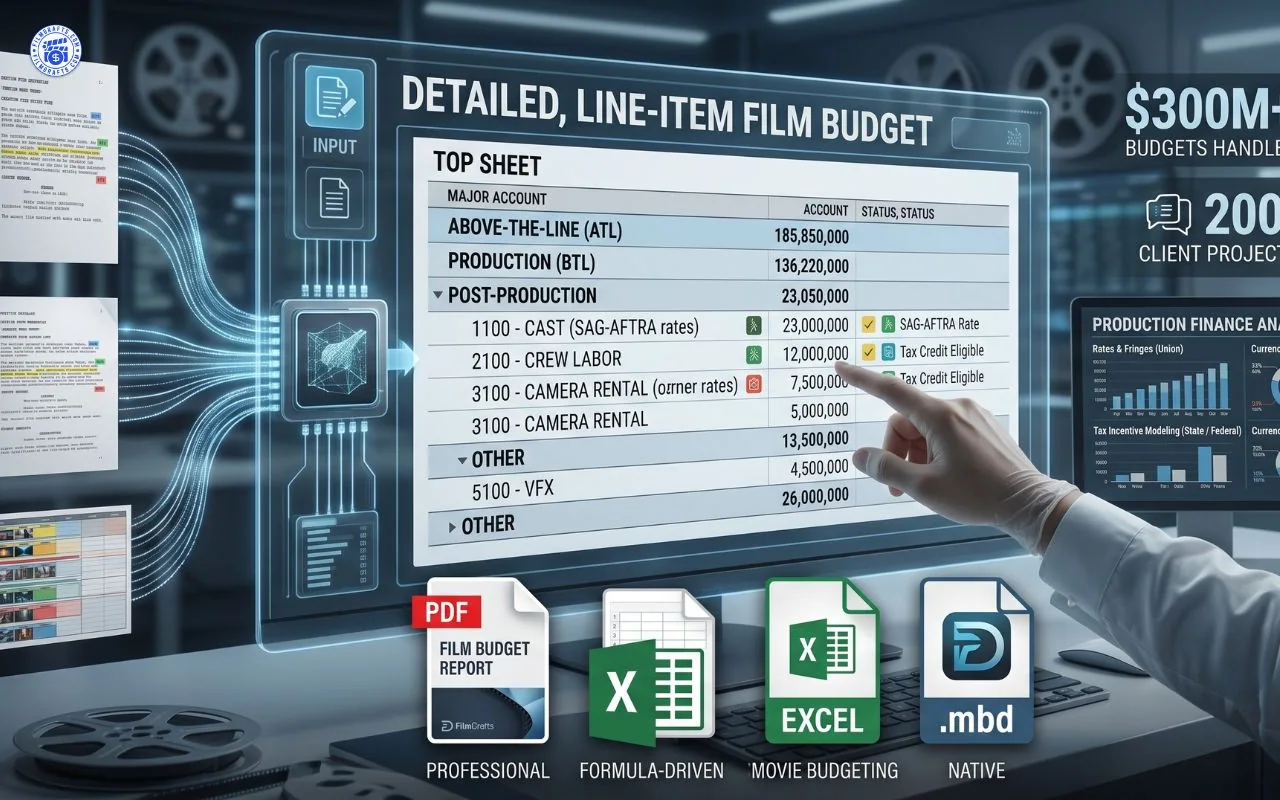
An independent film budget breakdown should answer two different questions: what will the movie cost, and how will the producer control that cost after the budget is approved? The first requires a complete account structure linked to the screenplay and schedule. The second requires commitments, actuals, estimates to complete, daily hot costs, and clear responsibility for every department.
The result is more than a movie budget breakdown. It is a production-control system that allows the team to see whether savings are real, whether overruns are developing, and whether contingency remains available for genuine unknowns.
Independent Film Budget Breakdown by Phase
Development
Rights, writing, research, development producers, initial legal work, early casting or packaging, concept materials, and preliminary budgeting. Identify which costs have already been spent and whether they are included in the production capitalization.
Pre-Production
Script breakdown, scheduling, casting, scouts, production office, department heads, design, permits, insurance binding, payroll setup, travel planning, tests, rehearsals, fittings, prep labor, deposits, and procurement.
Principal Photography
Cast, crew, equipment, locations, transport, catering, security, medical and safety, power, expendables, data, communications, effects, background, overtime, and daily operational costs.
Post-Production
Picture editorial, assistant editorial, storage, sound editorial, ADR, Foley, mix, score, music licensing, VFX, color, titles, mastering, captions, quality control, and review rounds.
Insurance, Legal, Payroll, Delivery, and Financing Costs
These costs may sit in separate account groups depending on the budget format. Include production insurance, errors and omissions, legal, payroll fees, employer burdens, audit, incentive administration, completion requirements, delivery materials, and any approved financing costs.
Contingency
Reserve contingency for uncertainty, not for known omissions. The amount should reflect the production's schedule, weather, travel, effects, location, vendor, and post-production risk.
Build the Breakdown From a Schedule
Most variable production costs are driven by time. The script breakdown and Movie Magic schedule establish cast days, crew weeks, equipment periods, location periods, company moves, night work, travel, prep, and wrap. Those quantities should flow into the detailed budget.
For example, changing a location-heavy schedule can affect location fees, transport, parking, police or fire support, crew hours, overtime, meals, equipment moves, and the number of pages achievable per day. A budget built independently from the schedule will not show the full effect.
Recommended Cost-Control Worksheet Columns
- Account and description, aligned with the approved budget.
- Approved budget, the authorized amount before changes.
- Purchase order or commitment, signed deals, quotes, rentals, locations, and vendor bookings.
- Actual cost, payroll, invoices, petty cash, cards, and payments processed.
- Estimate to complete, remaining work and open obligations.
- Final forecast, actual plus estimate to complete.
- Variance, approved amount less final forecast.
- Contingency request, approved movement, reason, and authorization.
- Department owner, person responsible for the forecast.
Daily Hot Costs During Principal Photography
A daily hot-cost report estimates the cost of the day before every invoice and payroll detail has been processed. It commonly tracks cast and crew labor, overtime, meal penalties where applicable, extras, equipment, locations, transport, fuel, catering, consumables, and unusual events.
The purpose is speed. If the production is exceeding the planned cost per day, the producer can adjust future schedule, staffing, rentals, or logistics before the variance becomes permanent.
How to Review Major Account Groups
Above-the-Line
Confirm cast deals, producers, director, writers, rights, travel, rehearsal, fittings, publicity or promotional obligations, fringes, agency or management fees where applicable, and any deferrals. The schedule should match cast workdays.
Crew and Production Operations
Review prep, shoot, and wrap periods; rate bases; workweeks; overtime; turnaround; kit fees; payroll burdens; travel; and department staffing. A lower headcount is not automatically efficient if it creates overtime, safety issues, or schedule delays.
Locations and Transportation
Include location fees, permits, parking, holding, base camp, power, security, police or fire support, cleaning, restoration, mileage, fuel, tolls, drivers, vehicle rentals, and company moves.
Equipment and Expendables
Separate packages from accessories, media, expendables, prep, tests, delivery, pickup, loss and damage, insurance requirements, and overtime or additional weeks.
Post and Delivery
Confirm the intended delivery standard and distribution pathway. Editorial alone is not the entire post budget. Include sound, music, VFX, color, titles, mastering, captions, legal, errors and omissions, quality control, and deliverables.
Illustrative Variance Review
Assume a location account has an approved budget of $20,000. Signed location agreements and permits total $15,000, actual payments are $8,000, and the remaining forecast is $9,500. The final forecast is $17,500, leaving a positive variance of $2,500. That saving is not automatically free cash: confirm restoration, overtime, utilities, security, parking, and final invoices before releasing it.
The same logic applies to every account. Variance should be based on the final forecast, not on cash paid to date.
Independent Film Budget Review Before Financing
- Does the budget match the latest screenplay and schedule?
- Are US union or non-union assumptions, rates, fringes, payroll, and work rules stated where relevant?
- Are tax incentives shown separately from gross production cost and supported by qualified-spend assumptions?
- Are all deferrals, donations, producer-supplied resources, exclusions, and open quotes disclosed?
- Do the top sheet, detailed budget, cash flow, business plan, and financial model use the same capital requirement?
- Is the producer clear about which financing sources are assumptions rather than committed funds?
FilmDrafts prepares budgeting and production-finance documents. It is not a film financing company and does not guarantee capital or returns.
Frequently Asked Questions
What is the difference between a film budget and a cost report?
The budget is the approved plan. The cost report compares that plan with commitments, actuals, estimates to complete, and final forecast so the producer can manage variance during production.
Should contingency be allocated to departments at the start?
Usually contingency is easier to control when held centrally and released through an approval process. The exact method depends on production governance and financing requirements.
Can a film budget breakdown help when approaching financing companies?
Yes, a clear budget can help capital providers understand use of funds and production assumptions. It does not replace underwriting, legal documents, due diligence, collateral, attachments, distribution strategy, or the investor's own criteria.
Related FilmDrafts Guides
Need a Project-Specific Film Budget?
FilmDrafts prepares screenplay-based budgets, schedules, business plans, financial models, recoupment waterfalls, and investor-ready production documents using assumptions tailored to the project.
Discuss Your Project →