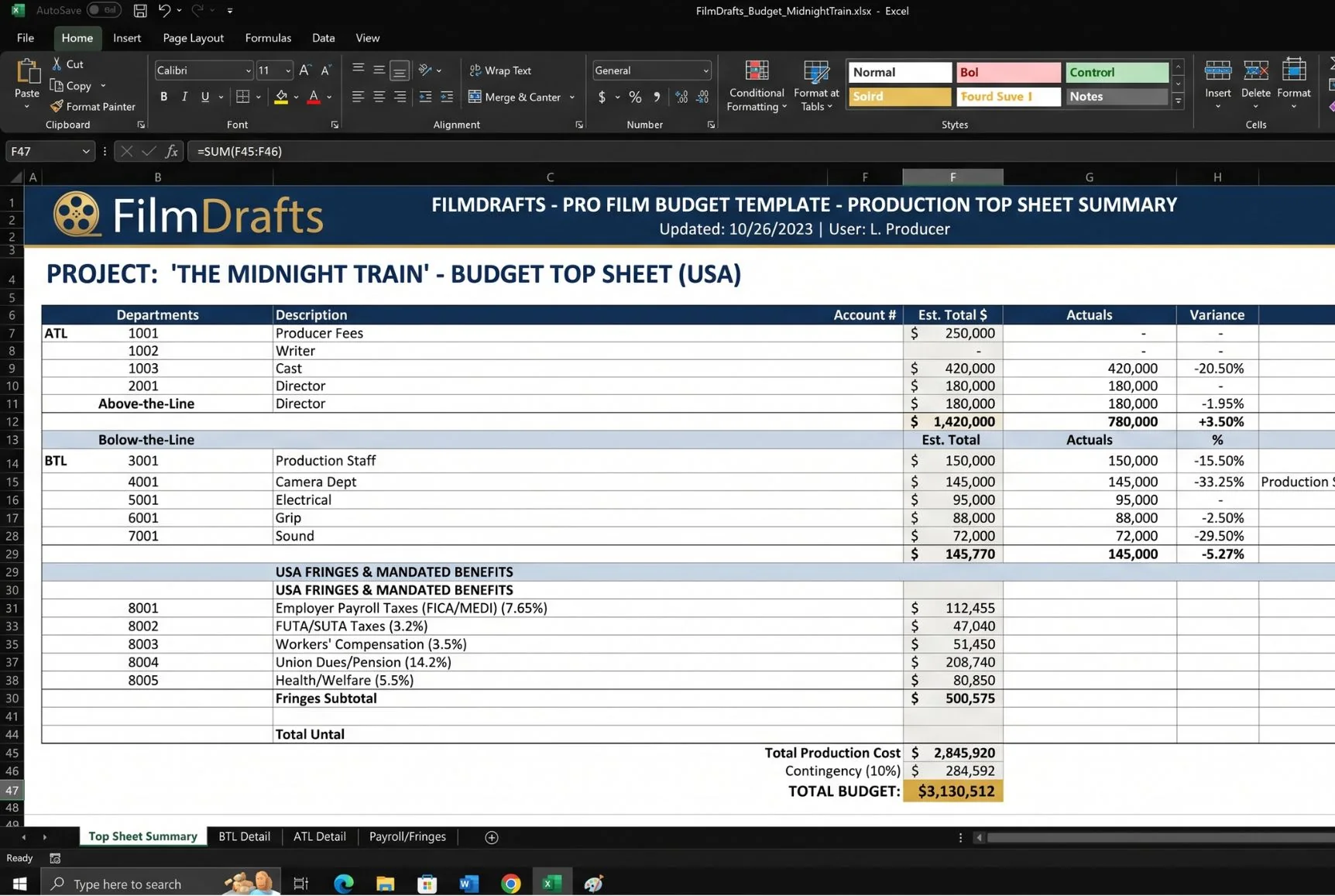
A low-budget film budget template is useful only when it forces the producer to define the production plan. A generic percentage split may look organized, but it cannot tell you how many cast days, crew weeks, location periods, equipment packages, travel days, post sessions, or delivery items the screenplay requires.
The most reliable template begins with the script breakdown and schedule, then converts those drivers into quantities, rates, fringes, allowances, and contingency. The workbook should make assumptions visible so the producer can revise scope without losing the logic behind the total.
Start With the Script, Not the Target Total
Many low-budget projects begin with a hard ceiling. That ceiling is a financing constraint, not proof that the movie can be produced for that amount. Break down the screenplay first, then test what must change if the first pass exceeds available capital.
- How many speaking roles, background days, minors, animals, stunts, or specialty performers are required?
- How many unique locations and company moves appear in the script?
- How many day, night, interior, exterior, travel, prep, and wrap days are implied?
- What equipment, vehicles, props, wardrobe, makeup, effects, music, and post-production work are story-critical?
- Which requirements can be redesigned creatively, and which are safety, legal, labor, insurance, or delivery necessities?
A script breakdown and shooting schedule turns those questions into a measurable production plan.
Recommended Low-Budget Film Template Structure
1. Assumptions Sheet
Record script version, format, target territory, currency, labor framework, shooting days, prep and wrap weeks, workweek, overtime treatment, payroll provider, rate sources, insurance basis, incentive assumptions, and any producer-supplied resources.
2. Film Budget Top Sheet
Summarize the major account groups and total cost. The top sheet is a review tool, not the calculation engine; every figure should roll up from detailed accounts.
3. Detailed Accounts
Use separate sections for development, above-the-line, production staff, crew, art, wardrobe, hair and makeup, camera, grip and electric, sound, locations, transportation, effects, post-production, insurance, legal, payroll burdens, travel, delivery, and contingency.
4. Rates and Fringes
Keep rates, taxes, payroll fees, pension and health, workers' compensation, sales tax, and other burdens in a controlled assumptions area. Apply them only to eligible accounts.
5. Cash Flow and Commitments
Track when deposits, payroll, rentals, locations, travel, post, and delivery costs are payable. Add columns for approved budget, committed cost, actual cost, forecast to complete, and variance.
Illustrative $250,000 Independent Feature Top Sheet
The following is a planning illustration—not a recommended percentage formula. Every project should be rebuilt from its own script and schedule.
- Development and pre-production: $18,000
- Above-the-line: $42,000
- Production crew, equipment, locations, transport, and operations: $112,000
- Post-production, music, and delivery: $48,000
- Insurance, legal, payroll burdens, and other indirect costs: $18,000
- Contingency: $12,000
The value of the example is not the split. It shows that the gross cost must include more than cast and shooting. A producer should then open each group and calculate the actual line items.
Build the Budget From Schedule Drivers
A practical low-budget template should connect each recurring cost to a measurable driver:
- crew rate × paid days or weeks;
- equipment package × rental weeks, prep, and return periods;
- location fee × prep, shoot, hold, restoration, and overtime periods;
- cast rate × workdays, rehearsal, fitting, travel, and applicable overtime;
- vehicle or transport rate × days, mileage, fuel, parking, tolls, and drivers;
- post vendor rate × edit, sound, color, VFX, mastering, and review rounds.
When the schedule changes from twelve days to fifteen, the template should reveal which accounts move. That is why a formula-driven workbook is more useful than a static PDF.
US Payroll, Union, and Fringe Considerations
For a US production, wages are only part of labor cost. Depending on the project and worker classification, the budget may need employer payroll taxes, workers' compensation, payroll-processing fees, pension and health contributions, vacation or holiday pay, kit or box rentals, mileage, per diem, overtime, turnaround, and travel days.
Do not apply one blanket percentage to all labor. Build separate fringe bases and verify the current agreement, rate sheet, payroll provider, state requirements, and production circumstances. The SAG-AFTRA low-budget guide explains why agreement selection and timing matter.
Contingency Is a Risk Decision, Not a Plug
A low-budget production still needs a plan for uncertainty. The appropriate contingency depends on schedule compression, weather exposure, travel, stunts, effects, location control, vendor certainty, post complexity, and how many quotes remain open.
Keep contingency visible and separate. Do not use it to make an underfunded department appear complete, and do not assume it can replace insurance, safety, legal, payroll, or delivery costs.
Cost-Control Columns to Add
- Approved budget: the authorized amount.
- Committed: signed deals, purchase orders, or confirmed bookings.
- Actual: invoices, payroll, card spend, and paid costs.
- Estimate to complete: remaining forecast.
- Final forecast: actual plus estimate to complete.
- Variance: approved budget minus final forecast.
- Owner and status: responsible department and open/quoted/approved/paid status.
During photography, daily hot-cost reporting helps the producer see payroll, overtime, meals, transport, locations, and equipment variances before the weekly cost report arrives.
Where Low-Budget Templates Commonly Fail
- They budget a camera but omit media, data management, expendables, prep, tests, insurance, and returns.
- They include crew day rates but omit prep, wrap, overtime, payroll burdens, kits, travel, and fringes.
- They use free locations without permits, control, parking, power, restrooms, holding, security, restoration, or company moves.
- They reserve too little for sound editorial, ADR, music, color, mastering, captions, legal, insurance, and final delivery.
- They show tax incentives as immediate cash without timing, audit, eligibility, fees, lender costs, or monetization assumptions.
Template vs Professional Film Budget Service
A template can help a producer organize assumptions and test early versions. A professional film budget service is more appropriate when the project needs a screenplay-based schedule, current rate research, Movie Magic Budgeting, detailed account reports, union or non-union assumptions, incentive treatment, or review by investors, lenders, studios, production accountants, or completion-bond professionals.
FilmDrafts does not provide financing or guarantee that a budget will be funded. We prepare production and financial documents that help decision-makers understand the plan.
Frequently Asked Questions
Can I use this template for a short film or TV pilot?
Yes, but the account structure and schedule drivers should be adapted to the format. A pilot may require series-specific cast, writers' room, standing-set, post, and delivery assumptions; a short film may use fewer accounts but still needs complete labor, insurance, post, and delivery planning.
How much contingency should a low-budget film include?
There is no universal percentage. Set contingency after reviewing schedule, weather, travel, stunts, locations, effects, vendor certainty, open quotes, and post-production risk. State the basis clearly.
Should incentives reduce the gross budget?
Keep gross production cost and expected incentive proceeds visible as separate values. Confirm eligibility, qualified spend, timing, audit, fees, lender or monetization costs, and professional advice before treating an incentive as available financing.
Need a Project-Specific Film Budget?
FilmDrafts prepares screenplay-based budgets, schedules, business plans, financial models, recoupment waterfalls, and investor-ready production documents using assumptions tailored to the project.
Discuss Your Project →