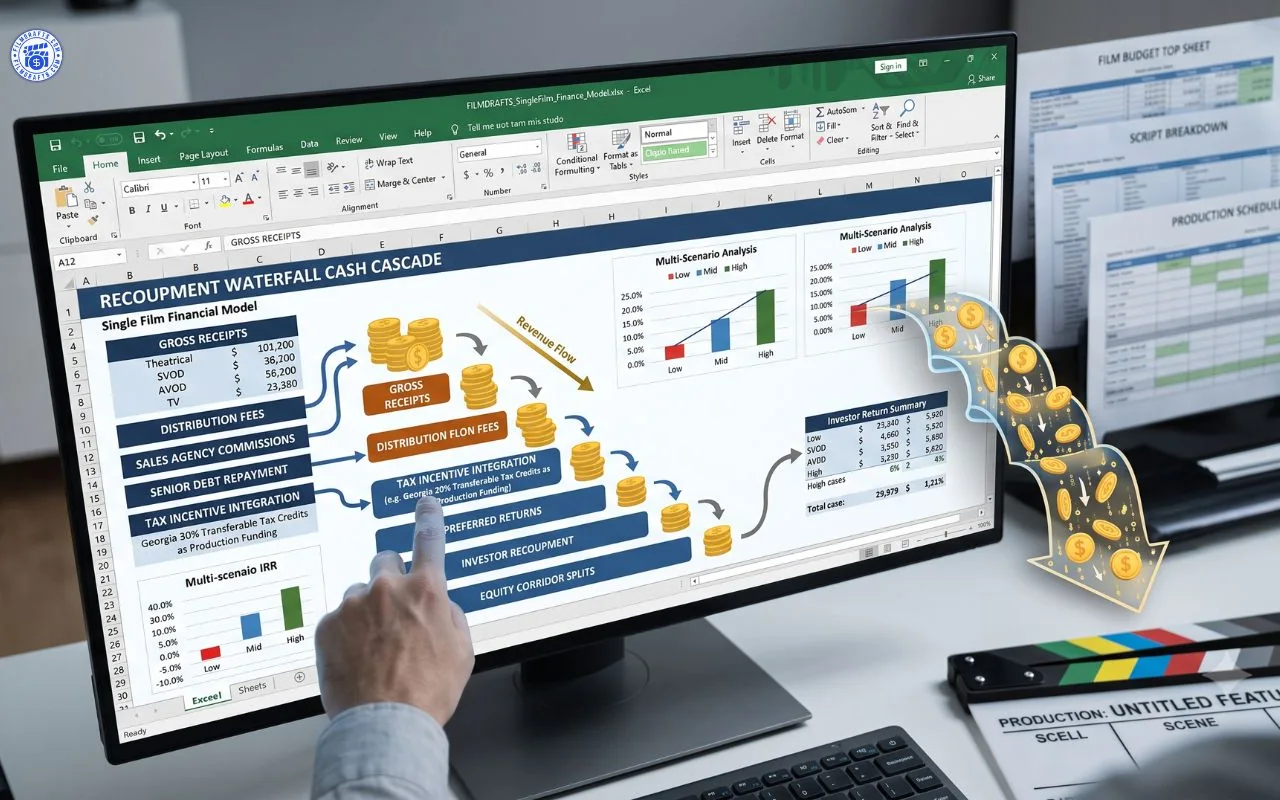
A film recoupment waterfall sets out who receives available film receipts, in what order and under which conditions. Producers use it to explain the commercial terms behind a financing plan. Investors use it to examine how much capital remains outstanding when the film performs above or below expectations.
This guide compares payment structures and walks through a hypothetical example. It explains modeling choices rather than proposing legal terms for a particular investment. The companion step-by-step waterfall modeling guide focuses on building and checking the workbook.
Start With the Definition of Receipts
Worldwide box office, distributor receipts and cash available to the production are different figures. A model must state its starting point. If an input already represents receipts after an exhibitor share, do not deduct that share again. Likewise, if a sales estimate is already net of a distributor fee, applying the fee again understates the cash available.
Document the collection arrangement, revenue channels, currency and payment timing. State which costs are deducted before cash enters the investor waterfall and which are paid inside it. The same expense should not appear in both places.
Priority and Proportional Sharing Answer Different Questions
Priority determines which claim is paid first. Proportional sharing determines how money is divided among participants within a class. These concepts can exist together: senior debt can be repaid before an equity class whose members then recoup proportionally.
Pari passu equity generally means equal ranking under the specified terms, with allocations commonly based on each investor's share of the relevant class. It does not by itself promise a higher return. Preferred returns, catch-ups, profit splits and repayment priorities must each be defined separately.
Illustrative Film Recoupment Waterfall
Assume a hypothetical film has $3,000,000 of equity financing and a $2,000,000 senior loan. The agreed example repays debt and $160,000 of loan interest first, returns equity principal next, and then pays a one-time preferred return equal to 10% of equity capital. Remaining profit would be split 80% to equity and 20% to the producer. These are invented terms for demonstration, not market standards.
Assume $7,500,000 of distributor-level receipts before a 30% distribution fee. This example excludes other distribution expenses solely to make the arithmetic easy to follow. The fee is $2,250,000, leaving $5,250,000 for the modeled payment sequence.
- Senior loan and interest: pay $2,160,000. Cash remaining is $3,090,000.
- Equity principal: return $3,000,000. Cash remaining is $90,000.
- Preferred return: the calculated claim is $300,000, but only $90,000 is available. Pay $90,000 and carry $210,000 as unpaid preference under the assumed terms.
- Profit split: no distributable profit remains, so neither party receives a profit allocation in this period.
Total waterfall payments are $5,250,000, exactly equal to the available cash. Equity receives $3,090,000, of which $3,000,000 is returned capital and $90,000 is return. This distinction prevents the workbook from labeling all investor distributions as profit or skipping equity principal before a producer split.
Test the Next Receipt and the Downside Case
If a further $1,000,000 becomes available inside this example's waterfall, the model first pays the $210,000 preference balance. The remaining $790,000 is profit: $632,000 goes to equity and $158,000 to the producer. The sequence must preserve balances from the previous period.
Now test a weaker case with only $1,500,000 initially available for the waterfall. That amount goes toward the senior claim, leaving $660,000 of the assumed debt-and-interest claim unpaid. Equity principal, preferred return and profit distributions are all zero. A model that pays later tiers while the agreed senior claim is still outstanding needs correction.
Keep Incentives and Financing Proceeds Distinct
A production incentive is not automatically unrestricted profit. If an incentive-backed loan has financed production, the receipt may be committed to that loan under the financing documents. Model the actual source, timing and repayment obligation instead of treating the same incentive as both a budget reduction and free cash for equity.
Eligibility and recapture depend on the applicable program and compliance requirements. Weak box office alone should not be presented as a universal reason for tax-credit clawback. Confirm the program-specific treatment with the relevant advisers.
Translate the Agreed Terms Into a Reviewable Model
Collect the financing sources, distribution assumptions, lender terms, equity contributions, preference definition and participation rules. Identify unresolved points before building formulas. Distinguish simple from compounding preference, define whether it accrues on invested or unreturned capital, and state how partial payments affect future balances.
Our film financial model and recoupment waterfall service connects these assumptions to cash timing and return scenarios. The international feature financial-model case study shows how a model can support a coordinated business plan and investor overview.
When a Slate Needs Another Layer
A multi-film fund must distinguish money available at each project from money available to the fund. Project distributions may feed a separate fund waterfall with its own capital, fees and participation terms. Our film slate modeling service addresses that consolidation; more complex structures can require institutional film finance modeling.
Frequently Asked Questions
Is there one standard film waterfall?
No. The sequence reflects the financing and distribution terms. Use a labeled example to understand the logic, then model the project's actual terms.
Does a preferred return guarantee payment?
No. A contractual priority does not create cash. The model should show both the amount due and the amount available to pay it.
Can changing the spreadsheet change the deal?
No. A revised model illustrates revised assumptions. Changes to binding terms require the appropriate agreement and professional review.
Related FilmDrafts Guides
Need Production Finance Support for Your Film?
FilmDrafts prepares professional budgets, schedules, business plans, financial models, recoupment waterfalls, and investor-ready production documents tailored to the requirements of each project.
Discuss Your Project →