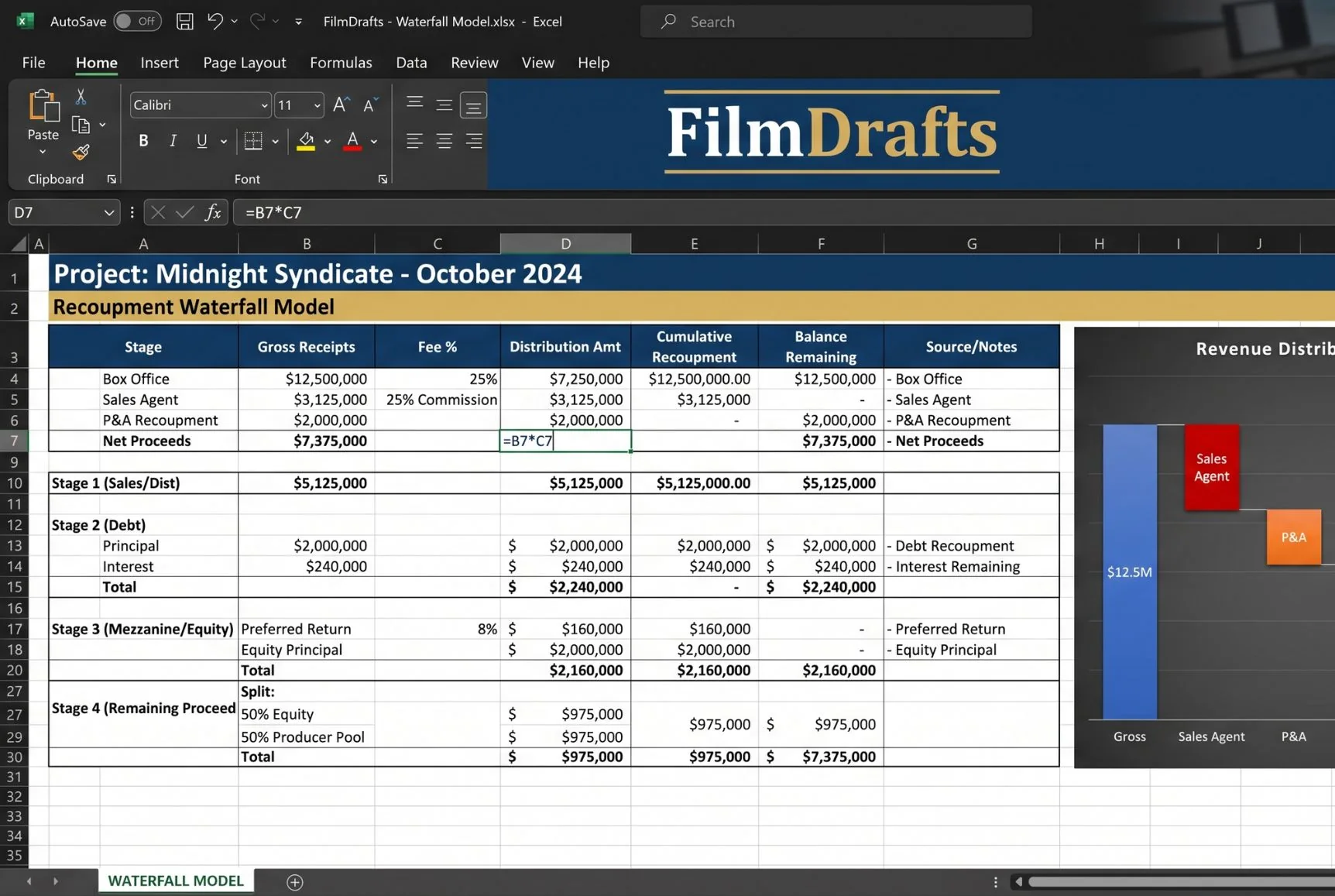
A film recoupment waterfall model turns financing and distribution terms into a traceable sequence of cash payments. A useful workbook shows what is available, what each participant is owed, what has been paid and what remains outstanding. It should continue to work when revenue arrives late or falls below the base case.
This guide explains the spreadsheet workflow. For a numerical example of debt, equity principal and preferred-return tiers, read how film recoupment waterfalls work. Build the model from the project's agreed terms and have the relevant advisers confirm how those terms should be interpreted.
1. Gather the Inputs and Define the Model Boundary
Start with the approved production budget, financing sources, expected receipt dates, distribution terms, debt schedule, equity contributions and participation provisions. Record each input's source and status. A signed agreement, a distributor estimate and a producer assumption should be distinguishable in the workbook.
Decide whether the model starts from box office, distributor receipts or producer receipts. Define the currency, reporting period and treatment of cash reserves. Your production budget establishes the cost requirement; the waterfall explains how available receipts are allocated under the financing structure.
2. Build Revenue by Channel and Period
Separate theatrical, licensing, television, digital and other relevant receipts. For each channel, identify the payment basis and when money is expected to reach the collection account or production entity. Do not apply theatrical exhibitor deductions to a licensing amount that is already defined as payable to the rights holder.
Use clearly labeled downside, base and upside assumptions. A comparable film's box office is not the same as the cash your project will receive. Show the steps from a market-performance assumption to the modeled receipt, and record any gaps in the evidence.
3. Apply Distribution Deductions Once
Create separate lines for applicable distributor fees, sales commissions, recoupable expenses, reserves and collection costs. State the base used for each percentage, the order of deductions and any cap. If a sales estimate is supplied net of fees, make that explicit and avoid charging those fees again.
A minimum guarantee is not simply the larger of a commission and a fixed amount. Model advances, recoveries and overages according to the actual distribution terms, keeping the initial payment and its later recoupment connected. The commercial definition matters more than the label used in a template.
4. Build the Debt Schedule
Track opening principal, new draws, interest, fees, repayments and closing principal by period. Feed only the amounts that the terms require into the waterfall. If a loan is secured against a particular source of receipts, represent that restriction rather than treating all money as interchangeable.
For an illustrative $100,000 outstanding claim with $60,000 available at its priority tier, payment is $60,000 and the unpaid claim is $40,000. The next tier receives no cash in a strict sequential structure. Neither the payment nor the cash balance should become negative.
5. Return Equity Principal and Calculate Preference
Maintain separate balances for contributed capital, returned principal, accrued preference and preference paid. Confirm the agreed order: some structures return capital before preference, while others specify another sequence. Do not substitute a preferred-return payment for the return of the investor's original capital.
If equal-ranking investors contribute $300,000 and $200,000 to one class, their capital shares are 60% and 40%. Under a proportional capital-return rule, a $100,000 payment to that class returns $60,000 and $40,000 respectively. Keep each investor's remaining balance visible.
6. Allocate Remaining Profit Under the Terms
Once prior claims are satisfied as required, allocate distributable profit using the agreed percentages. Model any catch-up or changing participation tier explicitly. Check that the percentages for each allocation total 100% and that the same cash does not fund more than one tier.
Keep producer fees, deferred compensation and profit participation separate. They can have different definitions and payment priorities. A summary labeled investor return should also distinguish capital repayment from gain.
7. Add Reconciliation Checks
- Opening cash plus receipts less payments equals closing cash for every period.
- Each tier pays no more than the amount available and the amount due under its rule.
- Opening unpaid claims plus new claims less payments equal closing unpaid claims.
- Investor-level payments sum to the payment allocated to their class.
- Project distributions reconcile to the investor summary without duplicate deductions.
- Zero-revenue and partial-recoupment cases do not create unsupported payments.
Keep checks visible beside the outputs so a reviewer can see whether an assumption change breaks the model. Test zero receipts, delayed receipts, a higher expense cap and cash that stops partway through a tier. A workbook that only works in the base case is not ready for review.
8. Present Returns With the Cash Timing
Show paid capital, outstanding capital, total distributions and net gain alongside any ROI, multiple or IRR calculation. Define the metric and the period covered. IRR requires a cash-flow pattern that supports a meaningful result; display a clear explanation when it cannot be calculated rather than forcing a value.
Connect funding dates and production payments through a production cash flow schedule. A project can show an attractive ultimate outcome while still encountering a financing gap before the expected receipts arrive.
Use a Workbook That Matches the Financing Structure
Excel is useful for editable, period-based modeling and scenario comparisons. Movie Magic Budgeting supports the production cost plan; do not assume a production budget file replaces a complete investor waterfall. FilmDrafts' film financial modeling service connects the cost basis, receipt assumptions and recoupment terms in a reviewable workbook.
For a fund or multiple films, keep project waterfalls separate from the consolidated fund logic. The 30-title slate financial-model case study illustrates why portfolio cash flows and fund distributions require another level of analysis.
Frequently Asked Questions
Should every waterfall use the same tier order?
No. The model must follow the supplied deal terms. Label illustrative structures and avoid presenting them as a universal contract.
Can the model show unpaid investor claims?
Yes. Carry outstanding principal and any applicable preference balances forward so later receipts follow the correct sequence.
What should I send FilmDrafts?
Share the budget summary, financing structure, available distribution assumptions and proposed recoupment terms. Request a financial-modeling scope so missing inputs can be identified before work begins.
Need Production Finance Support for Your Film?
FilmDrafts prepares professional budgets, schedules, business plans, financial models, recoupment waterfalls, and investor-ready production documents tailored to the requirements of each project.
Discuss Your Project →