
A film budget is ultimately a producer-side responsibility, but the person who actually builds it depends on the size and stage of the project. On an independent feature, the producer may prepare an early estimate personally. On a more developed production, a line producer or unit production manager (UPM) commonly turns the screenplay and schedule into a detailed working budget. Production accountants and department specialists can also contribute rates, payroll, vendor quotes and specialist cost assumptions.
If you are asking who makes a film budget because you need one for your own project, the practical choice is usually between three routes: build it yourself, hire an experienced line producer/UPM, or use a professional film budgeting service. The right route depends on whether you need a rough planning number, a production-ready cost model, or a deliverable suitable for serious financing and pre-production discussions.
Who Makes a Film Budget?
There is no single job title that creates every film budget. The responsibility changes as a project moves from development into prep and production.
An Entertainment Partners budgeting training guide describes the producer as generally responsible for creating the budget, while noting that a production manager, production accountant and specialist departments may assist. The Directors Guild of America lists preparing the script breakdown, preliminary shooting schedule and budget among core UPM duties. ScreenSkills likewise describes line producers as senior production personnel responsible for allocating money and keeping production on budget and on time.
| Role | Typical budgeting responsibility | Where the role is most useful |
|---|---|---|
| Producer | Sets the financial framework, approves assumptions and may create early estimates or smaller-project budgets. | Development, packaging, early financing and projects where the producer is also handling production management. |
| Line producer | Translates the script and schedule into production assumptions, department costs, labor, rentals, logistics, fringes and contingency. | Features, series, commercials and independent productions that need practical cost control tied to the shooting plan. |
| Unit production manager (UPM) | Prepares and controls the budget and schedule under the producer, especially in structured US production environments. | Productions with formal production-management teams and active pre-production/physical production. |
| Production accountant | Supports budgeting with payroll, coding, cost tracking, commitments and financial-control knowledge; often manages actuals once production begins. | Projects that need detailed accounting controls, cost reports and ongoing budget-vs-actual tracking. |
| Department specialists | Provide quotes and assumptions for complex areas such as VFX, stunts, construction, travel, post or specialty equipment. | Projects where specialist costs can materially change the budget. |
| Film budgeting service | Builds the budget as a defined deliverable from the screenplay, schedule and assumptions without requiring the producer to hire a full-time production manager. | Independent producers who need a professional budget before assembling the full physical-production team. |
Who Creates the First Budget vs the Final Production Budget?
The first number attached to a project is often not the same thing as the budget used to shoot it. During development, a producer may only need a range that answers questions such as whether the screenplay is broadly a $500,000 film or a $5 million film. That estimate can be useful for packaging, but it may rely on assumptions that have not yet been tested through a detailed script breakdown and shooting schedule.
As the project becomes more real, the budget should become more specific. Cast days, shoot days, locations, company moves, prep and wrap weeks, overtime exposure, rentals, travel, payroll burdens, insurance, post-production and contingency all need clearer logic. At that stage, the person preparing the budget is not simply entering numbers into a spreadsheet; they are translating production decisions into cost.
This is why the budget is normally revised more than once. A financing model, a greenlight budget and the budget used during physical production may be related, but they are not necessarily identical versions.
What Does a Film Budget Include?
A professional film budget typically starts with a top sheet and then drills down into account-level detail. The exact account structure varies, but common sections include above-the-line costs, production staff, cast, camera, grip and electric, art department, wardrobe, locations, transportation, travel, insurance, payroll burdens, post-production, delivery and contingency.
In Movie Magic Budgeting, the budget is organized through a topsheet, categories, accounts and detail lines. That structure is useful because the headline total is traceable back to quantities, rates and formulas instead of existing as a single unexplained estimate.
If you want the full mechanics, see our step-by-step guide to making a detailed film budget and our explanation of a film budget top sheet.

Can You Make a Film Budget Yourself?
Yes. A producer can build a film budget personally, and for some projects that is the sensible choice. A short film, microbudget project or early proof-of-concept may not justify hiring a specialist before the creative scope is stable.
DIY budgeting can work when
- the project is small and operationally simple;
- you only need an early planning estimate;
- you understand the screenplay, schedule and local production costs;
- you have time to research rates, rentals, payroll burdens and contingency;
- you are comfortable revising the budget as assumptions change.
DIY budgeting becomes risky when
- the screenplay contains many locations, company moves, stunts, effects, vehicles, crowds or specialty requirements;
- cast availability and schedule design materially affect cost;
- union, payroll, fringe or overtime assumptions need to be modeled carefully;
- the project spans multiple states or countries;
- the budget will be used in serious conversations with investors, lenders, production partners or incentive advisers;
- you are relying on a generic template without connecting it to a breakdown and schedule.
A template is not inherently bad. The problem is treating a template as if it already knows your screenplay. Our film budget template vs professional budget guide explains that distinction in more detail.
When Does a Line Producer Build the Budget?
A line producer is usually valuable when the budget needs to reflect how the film will actually be made. That means connecting creative requirements to a practical production plan.
For example, a script may appear inexpensive because most scenes are dialogue. But if those scenes require multiple locations, night work, child performers, picture vehicles, large background counts or difficult company moves, the schedule may create substantial labor and logistics costs. An experienced line producer should identify those relationships rather than budgeting each department in isolation.
ScreenSkills describes line producers as being at the heart of production, with responsibility for allocating money and helping ensure filming is completed on budget and on time. In practice, that often makes the line producer the bridge between the producer's financial target and the department-by-department plan.
You can read our separate guide on what a line producer does in film for the broader role across prep and production.
What About a Unit Production Manager?
In US film and television production, the UPM can have explicit responsibility for preparing the budget and preliminary shooting schedule. The DGA's description of UPM duties includes script breakdown, preliminary scheduling, budgeting, locations and day-to-day production management under the producer.
That does not mean every independent film needs to hire a DGA UPM before it can have a useful budget. It means that once a project is operating within a formal physical-production structure, budgeting and scheduling become part of an ongoing management function rather than a one-time spreadsheet exercise.
What Does a Professional Film Budgeting Service Do?
A professional budgeting service separates the deliverable from the ongoing production-management role. Instead of hiring someone to run the physical production, the producer sends the screenplay and project assumptions to a specialist team that prepares the planning documents.
Depending on scope, that can include:
- script breakdown and production-element review;
- preliminary or detailed shooting schedule;
- DOOD or cast-workday logic;
- budget top sheet and account-level detail;
- rates, fringes, payroll and labor assumptions;
- equipment, locations, travel and logistics assumptions;
- post-production, insurance, delivery and contingency;
- editable Movie Magic Budgeting or formula-driven Excel files;
- PDF reports and revision notes.
That route is especially useful before the full crew is hired. It gives the producer a structured baseline that can later be revised by the project's line producer, UPM, accountant or department heads as quotes and production decisions become firm.
DIY vs Line Producer vs Film Budgeting Service
| Question | DIY | Line Producer / UPM | Budgeting Service |
|---|---|---|---|
| Best use | Early planning, microbudget work, learning the process. | Active prep and production where the same person will help manage execution. | Getting a professional breakdown/schedule/budget package before or without hiring a full production-management team. |
| Project-specific? | Only as good as your own research and assumptions. | Yes, with direct involvement in production decisions. | Yes, when built from the screenplay and stated assumptions. |
| Scheduling connection | Optional; often weak if a template is used alone. | Usually strong because schedule and budget are managed together. | Can be strong when breakdown and scheduling are included in the scope. |
| Ongoing on-set management | No. | Yes, depending on engagement and role. | Usually no; the core service is a planning deliverable unless additional support is contracted. |
| Producer time required | Highest. | Lower for document construction, but the producer still makes major approvals. | Lower; producer supplies inputs, reviews assumptions and gives revision notes. |
| Good for financing discussions? | Only if sufficiently detailed and defensible. | Often, especially when tied to a realistic schedule and production plan. | Can be, provided the service delivers project-specific detail and clearly states assumptions. |
There is no universal winner. The key question is whether you need to learn and build the budget yourself, hire someone who will also manage physical production, or buy a professional planning deliverable.
How to Get a Film Budget Made
If your goal is to get a usable budget rather than learn budgeting from scratch, prepare the project information before you contact a line producer or budgeting service. Better inputs produce better assumptions.
1. Provide the latest screenplay
The script is the blueprint for the production. If the screenplay changes materially after budgeting begins, expect the schedule and budget to change too.
2. State the format and target scale
Feature, short, pilot, episodic series, commercial and documentary projects are structured differently. It also helps to say whether the project is microbudget, low budget, mid-budget or targeting a specific financing ceiling.
3. Identify likely shooting locations
Country, state and city can affect labor, travel, permitting, rentals, incentives and currency assumptions. If the location is undecided, ask for clearly labeled scenarios rather than pretending one location is certain.
4. Share known cast and union assumptions
Known talent, union status, number of principal cast, extras and special performer needs can materially change cost.
5. Share any existing schedule or production constraints
Actor availability, required shoot windows, nights, travel, weather, stage availability and fixed delivery dates should be known before the schedule is finalized.
6. Provide real vendor quotes when you have them
Camera, grip, post, locations, transport, insurance and specialty quotes are more useful than generic internet averages. A professional budget should distinguish known quotes from estimates.
7. Decide what files you actually need
Ask whether the deliverable includes PDF reports, editable Excel, Movie Magic Budgeting, Movie Magic Scheduling, a top sheet, detailed accounts, assumptions and revision rounds.
How FilmDrafts Fits Into This Decision
FilmDrafts is the done-for-you planning route, not a replacement for every line producer or UPM. If you already have an experienced physical-production team attached, that team may be the right group to own the budget. If you are earlier in the process and need a structured budget package before hiring the full crew, a remote specialist can be more efficient.
Our Detailed Film Budget Service & Movie Magic Budgeting is built from the screenplay and project assumptions. Depending on scope, FilmDrafts can prepare the breakdown, shooting schedule, DOOD logic, detailed budget top sheet, account detail, editable Movie Magic or Excel files and PDF reports.
If you only need breakdown and scheduling, see our Script Breakdown & Scheduling service. If you are not sure which deliverables you need, the services overview shows the available planning packages.
A Real Example: From Screenplay to a $6M Production Plan
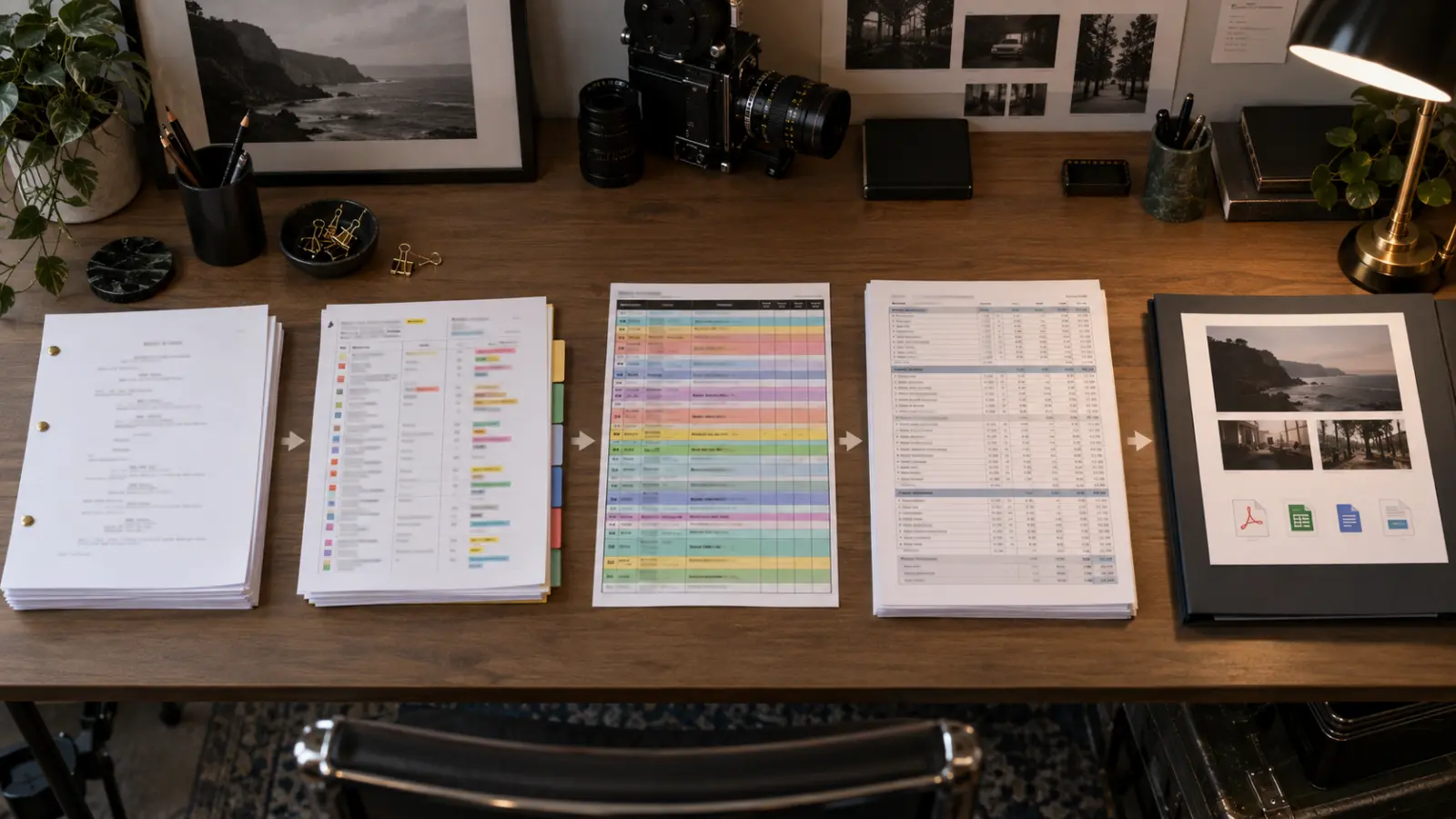
One useful way to judge a budgeting service is to look at the workflow rather than marketing claims. In our anonymized action-drama feature case study, a screenplay was developed into a scene breakdown, a 38-day shooting schedule, a detailed Movie Magic budget and supporting business-plan materials.
The point is not that every project should have a 38-day schedule or a $6 million budget. The point is that the number came after production assumptions were organized. That same logic applies at lower budget levels: the more the budget is tied to the actual screenplay and schedule, the easier it is to explain, revise and control.
What Should You Look for Before Hiring Someone to Make the Budget?
Whether you hire a freelancer, line producer or specialist service, ask questions that reveal how the budget is being built.
- Is the budget screenplay-based? A generic template should not be sold as a custom production budget.
- Is a schedule included or reviewed? Shoot days drive major labor and rental costs.
- Are assumptions documented? Rates, locations, currency, union status and contingency should not be hidden.
- Will you receive editable source files? You may need to revise the budget later.
- What is the revision process? Budgeting is iterative, especially before financing and prep are locked.
- What is outside the scope? Legal, tax, accounting, payroll and incentive advice may require separate qualified professionals.
A polished PDF is not enough on its own. The useful question is whether someone else can understand how the number was constructed.
Related FilmDrafts Guides
Frequently Asked Questions
Who makes a film budget?
A producer is generally responsible for the budget, but a line producer or UPM often prepares the detailed production budget. Production accountants and department specialists may supply additional cost information.
Who creates a film budget for a movie?
For an independent movie, the budget may be created by the producer, line producer, UPM or a professional budgeting service. Larger productions typically involve more department heads, accounting input and vendor quotes.
Who prepares a film budget?
The person preparing the budget should understand both the screenplay and the physical-production plan. Depending on the project, that may be the producer, line producer, UPM, production manager or a specialist budgeter working with the producer.
Who sets the budget for a film?
The person who builds the detailed budget is not always the person who approves the spending ceiling. Producers, financiers, studios or production companies may set or approve the target, while the line producer or UPM works out how the production can operate within it.
Who pays the budget of a film?
The budget is a plan for spending; it is not the source of the money. Production costs may ultimately be funded through producers, investors, studios, lenders, grants, presales, incentives or other financing structures. FilmDrafts does not provide or arrange financing.
Can a producer make a film budget?
Yes. Producers often create early estimates and some prepare full budgets themselves. The key is whether they have enough production, scheduling and rate knowledge for the level of detail the project requires.
Does a line producer create the budget?
Very often. Building and controlling the production budget is a core part of many line-producer roles, especially when the person is also responsible for the practical plan to execute the film.
Does a UPM prepare the film budget?
Yes, in many US production structures. DGA-described UPM duties include preparing the script breakdown, preliminary shooting schedule and budget under the producer's supervision.
What does a film budget include?
A detailed budget can include above-the-line costs, cast and crew labor, payroll burdens, equipment, locations, art, wardrobe, transportation, travel, insurance, post-production, delivery, contingency and other project-specific accounts.
How do I get a film budget made?
Send the latest screenplay plus your known production assumptions to a qualified line producer, UPM or budgeting service. Include likely locations, union status, cast assumptions, target scale, schedule constraints and any real vendor quotes you already have.
Do I need a shooting schedule before a film budget?
A rough budget can be created before a final schedule exists, but a detailed production budget is stronger when the shooting schedule is developed alongside it. Shoot days directly affect payroll, rentals, locations, travel and many other costs.
Do I need Movie Magic Budgeting?
No single software package is mandatory for every independent film. Movie Magic Budgeting is widely used for structured production budgets, but a well-built formula-driven spreadsheet can also work when the project and recipients accept it. The more important issue is the quality and transparency of the assumptions.
How long does it take to make a professional film budget?
Turnaround depends on screenplay length, complexity, schedule requirements, locations, union assumptions and revision scope. A simple project can move faster than a multi-location feature with stunts, VFX, travel or multiple scenarios. Ask the provider for a project-specific timeline before engagement.
What should I send to a film budgeting service?
At minimum, send the latest screenplay and a short project brief. Useful additional information includes intended shooting location, target budget range, union/non-union assumptions, known cast, desired schedule, currency, incentive plans and vendor quotes.
Can a film budget be revised after it is finished?
Yes. Film budgets are working models. New cast deals, schedule changes, quotes, locations, exchange rates, incentive decisions and creative revisions can all require updates.
Need a Professional Film Budget Without Building It Yourself?
Send FilmDrafts your screenplay and project assumptions. We can prepare the breakdown, shooting schedule and detailed production budget as a done-for-you planning package.
View Film Budget Service →