
A detailed film budget does not begin with numbers. It begins with production decisions. How many shooting days will you need? Which scenes require special equipment? How long will departments prep and wrap? Which cast members travel? Which agreements apply? Which wages carry pension, health, payroll taxes, workers' compensation or other fringes? What insurance does the production actually need? Which costs may qualify for a tax credit or rebate?
Until those questions are answered, a spreadsheet is only a container.
The most reliable way to make a detailed film budget is to move in a fixed order: screenplay, script breakdown, shooting schedule, production assumptions, rates, fringes, detailed accounts, incentives, top sheet and final stress test. That sequence is what turns a target number into a production plan.
What Is a Detailed Film Budget?
A detailed film budget is the account-level financial plan for producing the project. It should explain not only what the film is expected to cost, but how the cost was built. A top sheet may show that camera costs $85,000. The detailed budget should show the crew, package, rental periods, additional gear, expendables, prep, wrap and assumptions that created that $85,000.
That is why a detailed budget is different from a rough estimate, a one-page top sheet, or a generic template filled with round numbers.
| Document | Main purpose | Typical detail |
|---|---|---|
| Rough estimate | Early feasibility | Broad allowances and ranges |
| Top sheet | Executive summary | Major account groups and grand total |
| Detailed film budget | Production planning and review | Accounts, quantities, rates, fringes, assumptions and totals |
| Cost report | Production control | Budget vs commitments vs actuals vs estimate to complete |
If you need the summary side explained first, read our film budget top sheet guide. This article focuses on the detailed structure underneath it.
What You Need Before You Start Budgeting
Do not open Movie Magic or Excel and start typing department totals just because the screenplay is finished. A detailed budget needs a few planning inputs first.
- Locked or working screenplay: The version being budgeted must be identified.
- Script breakdown: Every scene should be translated into cast, background, locations, props, wardrobe, vehicles, stunts, special effects, VFX, animals, special equipment and other production elements.
- Shooting schedule: The schedule determines cast days, crew weeks, rentals, locations, hotels, transport, meal counts and many other quantities.
- Production location: Labor rules, payroll burdens, insurance, incentives, vendor rates and travel all depend on where the film is made.
- Union or non-union assumptions: You cannot price labor correctly until you know which agreements apply.
- Rate sources: Current agreements, payroll-company guidance, vendor quotes, crew rate books and local production knowledge.
- Currency and tax assumptions: Especially important for international productions.
FilmDrafts treats the breakdown and schedule as part of the budgeting workflow because they are. A budget that does not reconcile to the schedule is difficult to defend.
Step 1: Break Down the Screenplay Scene by Scene
Every budgetable element starts in the script. The breakdown converts creative language into production requirements. A restaurant scene may need cast, background, restaurant dressing, tables, food props, practical lighting, parking, holding and location control. A one-line action beat can create an entire cluster of stunt, safety, vehicle and effects costs.
For example, a line such as “an SUV crashes through a crowded street market at night” can touch stunt coordination, stunt performers, picture vehicles, vehicle prep, towing, location control, permits, police or security, background actors, lighting, special effects, resets, night work, overtime, insurance and possibly second-unit photography.
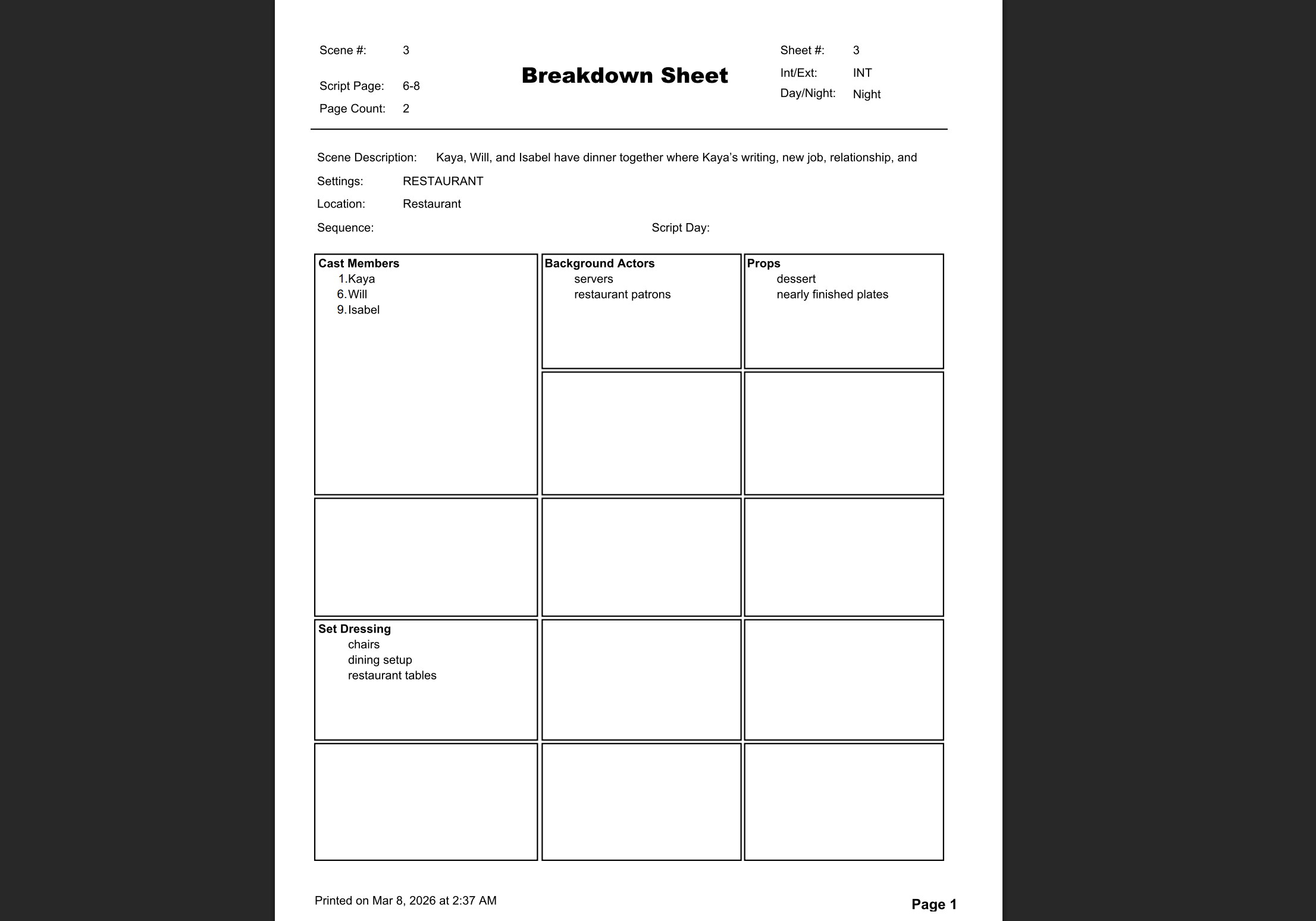
Do not budget categories that are not connected to the screenplay. And do not assume the breakdown is only an assistant director document. It is one of the inputs that tells the budget what exists.
Step 2: Build the Shooting Schedule Before Pricing the Budget
The shooting schedule turns script elements into time. Time then turns into money.
A two-day schedule increase can affect more than two crew days. It can extend equipment rental periods, location holds, production-office weeks, transport, hotels, insurance exposure, payroll, catering, prep and wrap. Cast availability can also force schedule shapes that change the rest of the budget.
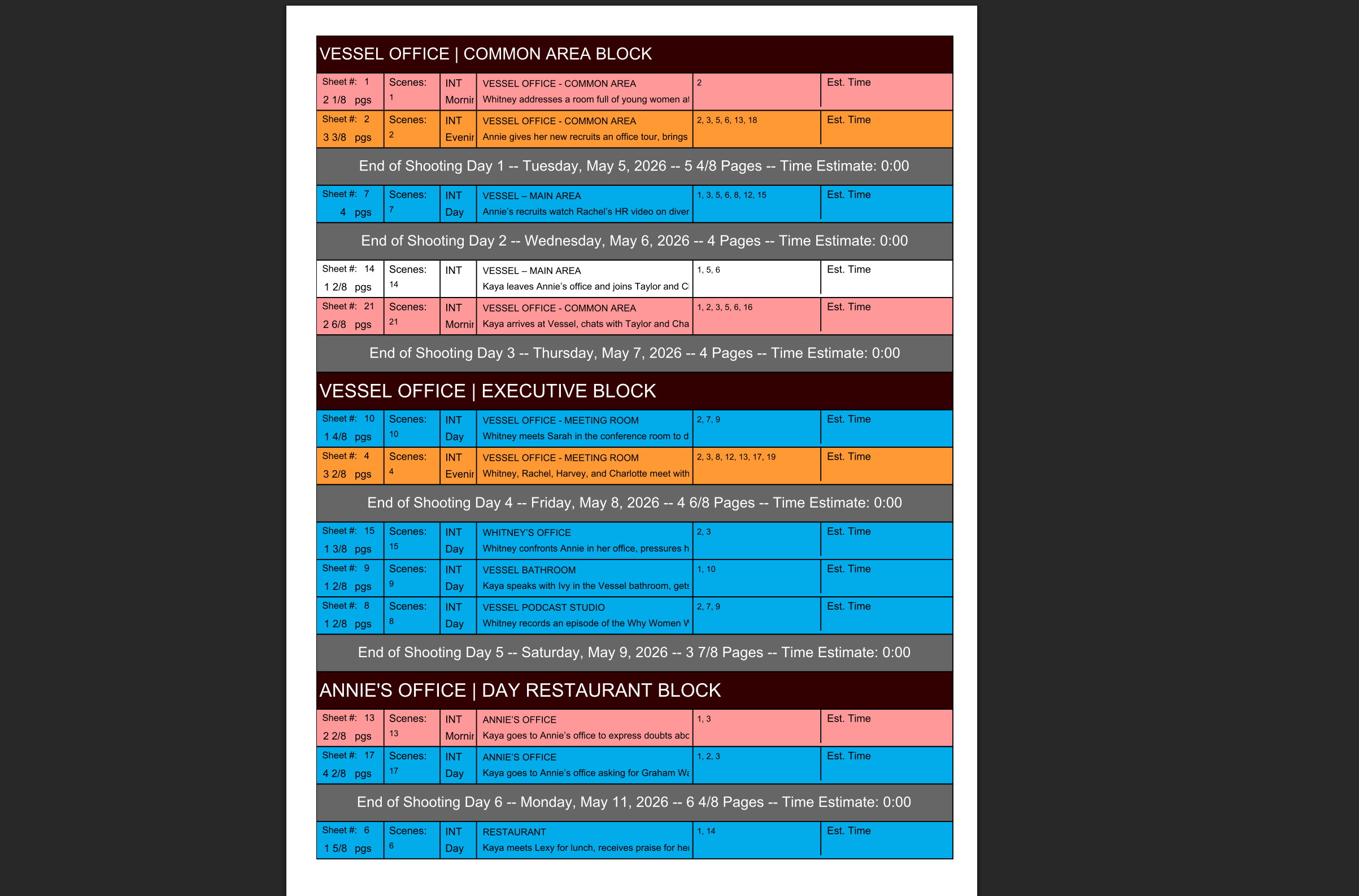
A useful budgeting rule is:
Base Cost + Applicable Fringes + Other Burdens = Budgeted Cost
The schedule provides much of the quantity and time. The budget provides the rate and burden logic.
Step 3: Write Down the Production Assumptions
Professional budgets are assumption-driven. If a major assumption lives only in someone's head, the budget is fragile.
Before pricing accounts, document the basis of the budget. Typical assumptions include:
- shooting city, state or country
- union status and specific agreement assumptions
- prep, shoot and wrap periods
- workweek and expected daily hours
- number of units
- stage vs practical-location strategy
- traveling cast and crew
- hotel, per diem and transport policy
- base currency and exchange-rate assumption
- tax-credit or rebate program being modeled
- payroll-company and workers' compensation assumptions
- contingency basis
Step 4: Structure the Film Production Budget Accounts
A detailed film production budget breakdown is easier to review when account groups follow the logic of production. Exact account numbers vary by template and software, but common areas include development and rights, writer, producers, director, cast, production staff, assistant directors, camera, grip and electric, sound, art department, construction, set dressing, props, wardrobe, hair and makeup, locations, transportation, travel, production operations, post-production, insurance, legal, accounting, general expenses and contingency.
Our separate guide to above-the-line vs below-the-line film costs explains the category logic in more depth. For this workflow, the important thing is consistency. Another producer should be able to move from the top sheet into the detailed accounts and understand where the total came from.
Step 5: Budget Above-the-Line Costs From the Deal and the Schedule
Above-the-line costs are often driven by negotiated agreements rather than simple department-week calculations. Typical accounts include story rights, writer, producer, director and principal cast.
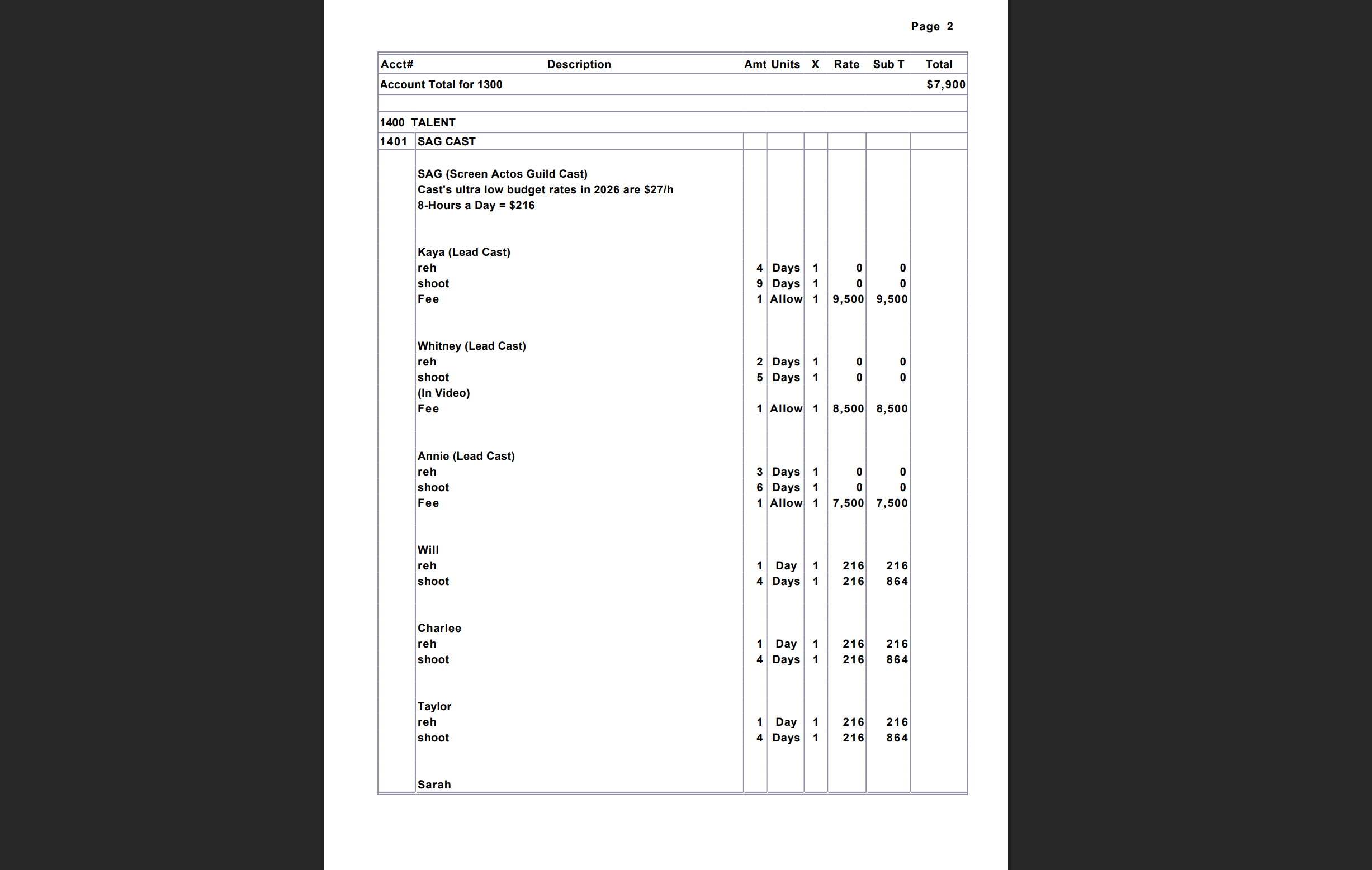
For cast, do not stop at the quoted acting fee. Depending on the project, you may also need to budget rehearsal, fitting, travel days, airfare, hotel, per diem, local transport, payroll fringes, union pension and health, overtime or premium conditions, and contractual allowances.
Rights can also involve option payments, purchase prices, legal work and extensions. Writer and director deals may include prep, production, post, travel and guild-related terms. The correct budget follows the actual deal or a clearly labeled assumption, not a generic percentage.
Step 6: Build Crew Costs From Prep, Shoot and Wrap
One of the most common amateur-budget mistakes is multiplying a crew day rate by the number of shoot days and calling the result complete.
Departments do not all start and finish together. The production designer may need substantial prep. Construction may build and strike. Camera may prep equipment before principal photography. Accounting and production staff can continue through wrap. Editorial can begin during production and continue long after the set is gone.
| Position | Prep | Shoot | Wrap | Rate basis | Extra considerations |
|---|---|---|---|---|---|
| Production Manager | Multiple weeks | Full shoot | Wrap period | Weekly | Overtime, fringes, travel |
| Director of Photography | Prep | Full shoot | Limited wrap | Weekly or negotiated | Kit, travel, premium time |
| Production Designer | Longer prep | Full/partial shoot | Strike/wrap | Weekly | Art-department labor overlaps |
| Editor | May start before shoot | During production | Long post period | Weekly | Assistant editor, storage, systems |
The schedule tells you the shoot period. Department logic tells you the prep and wrap around it.
Step 7: Understand Union vs Non-Union Budgeting
“Union” is not one rate and “non-union” does not mean “no fringes.” The labor structure has to be built from the agreements and jurisdiction that actually apply to the production.
Union productions
For SAG-AFTRA performers, the applicable agreement can depend on project type and budget level. As of September 2026, SAG-AFTRA's Low Budget Theatrical Agreement covers qualifying independent theatrical films under $2 million, while its Ultra Low Budget Project Agreement applies to qualifying films under $300,000. SAG-AFTRA's public low-budget pages also show Pension & Health contributions of 21% for principals, with agreement-specific terms that must be checked before budgeting. Always verify the current agreement directly with SAG-AFTRA Rates & Agreements.
DGA treatment is different. The DGA's 2026 Low Budget Theatrical Sideletter covers scripted theatrical films up to $11 million and uses multiple budget tiers with different obligations. That is a good example of why “add 20% for union” is not a budgeting method. Review the current DGA low-budget terms and the full applicable agreement.
Depending on the production and covered employees, union budgeting may need to account for minimum rates, guarantees, overtime, premium days, turnaround, meal penalties, pension and health, staffing requirements, travel rules and other contract-specific obligations.
Non-union productions
Non-union does not mean the wage is the final labor cost. Employer payroll taxes, workers' compensation, unemployment-related costs, payroll processing, statutory overtime, local labor law and employee-classification issues can still apply. A non-union crew rate of $350 per day is not automatically a $350 budget cost.
Where possible, confirm payroll assumptions with the payroll provider before locking the budget.
Step 8: Calculate Fringes Correctly
Fringes are additional labor costs calculated on top of wages or other eligible compensation. The exact components depend on the agreement, jurisdiction, employee classification and payroll setup.
Base wage = $2,000
Hypothetical applicable fringe burden = 24%
Fringe = $2,000 × 24% = $480
Budgeted labor cost = $2,480
The 24% above is not a recommended rate. It is only math. Real budgets may need multiple fringe groups, for example principal cast, union crew, non-union payroll, foreign payroll, background performers or special categories. Not every line item is necessarily fringeable, and not every fringe has the same base.
Build fringes as formulas whenever possible. Hard-typing them into totals makes revisions dangerous.
Step 9: Budget Equipment and Rentals by the Real Rental Period
Camera, grip, electric, sound, communications, vehicles and specialty equipment should not automatically be budgeted for shoot days only.
Check prep, pickup, test, travel, dark days, weekly rates, return days and wrap. Ask whether the quote includes expendables, additional batteries, media, lenses, carts, delivery, insurance certificates, expendables or specialty gear.
A ten-day shoot does not always mean ten rental days. The budget should follow the vendor terms and production calendar.
Step 10: Budget Locations and Production Logistics
A location fee is only one part of a location budget. You may also need permits, parking, holding, base camp, security, location management, cleaning, restoration, power, restrooms, neighbor agreements, police or fire support, generators and company moves.
Moves cost time as well as money. A schedule with too many company moves can create overtime and reduce shooting efficiency even if individual locations look cheap on paper.
Step 11: Add Travel, Lodging and Transportation
Travel-heavy productions are frequently underbudgeted because the producer counts flights and hotels but misses the operational details around them.
Depending on the project, include airfare, baggage and freight, airport transfers, local cars, fuel, parking, tolls, per diem, hotel taxes, early arrivals, hold days, visa or work-permit costs, drivers, passenger vans, cargo vehicles, unit trucks and return travel.
If cast or crew deals specify business class, companions, dedicated cars or special travel days, those assumptions belong in the budget too.
Step 12: Build the Post-Production Budget as a Real Department
Do not hide post-production inside one round-number allowance. Break it down.
Typical areas include editor, assistant editor, edit system, storage and backups, sound editorial, ADR, Foley, mix, music, licensing, composer, color, online, VFX, titles, captions, mastering, quality control and delivery materials. The exact structure depends on the release plan and technical requirements.
VFX should be based on a shot count and complexity assumption where possible. Music should separate score from licensed tracks. Delivery should reflect the actual distributor, broadcaster, streamer or festival requirements you are planning for.
Step 13: Budget Production Insurance Properly
Production insurance should not be a mystery allowance. The package depends on the production's scale and risk profile.
Common areas can include general liability, workers' compensation, rented equipment, hired and non-owned auto, property-related coverage, cast coverage where financing requires it, and specialty exposure for stunts, pyrotechnics, aircraft, marine work, animals, weapons or hazardous locations. Errors and omissions insurance is often associated with later delivery and distribution rather than basic principal-photography coverage.
Workers' compensation is not the same thing as general production insurance. Ask the broker what the policy actually covers, what the deductible is, what values are insured, and whether special activities need to be declared.
Step 14: Model Film Tax Credits, Rebates and Incentives Carefully
A tax incentive does not mean the entire production budget is reduced by the headline percentage. Incentives apply to qualified expenditure under specific rules.
For example, New York's current independent film program states that qualifying productions may receive a 30% credit on qualified production costs, with rules around qualified above-the-line wages, below-the-line costs, facility usage and minimum budgets. Georgia's program offers a 20% base credit with a potential additional 10% Georgia Entertainment Promotion uplift for qualifying projects, subject to certification and audit rules. Always use the current official program guidance, not an old blog post or a remembered percentage.
Official resources: New York State Independent Film Production Tax Credit Program and Georgia Film Incentives.
Total production budget = $2,000,000
Qualified spend = $1,200,000
Headline credit = 30%
Gross estimated credit = $1,200,000 × 30% = $360,000
Do not calculate $2,000,000 × 30% unless the entire $2,000,000 is actually qualified under that program.
Then go further. Budget application fees, CPA or audit costs, incentive financing costs, interest, monetization discounts and the timing of receipt. Also distinguish gross production cost from net production cost after the incentive. They are not the same number.
Step 15: Budget Multi-Currency Productions From Central Assumptions
International films often combine contracts and costs in several currencies. A UK crew may be paid in GBP, US cast in USD and post-production in CAD, while the producer wants the top sheet reported in USD.
Choose a base reporting currency and define exchange rates centrally. Do not type currency conversions independently into dozens of cells. If the GBP/USD assumption changes, connected accounts should update consistently.
For material foreign-currency exposure, consider an FX buffer or scenario. The budget should also note which contracts are actually denominated in which currency, because the risk sits where the obligation is fixed.
Step 16: Add General Expenses, Legal, Accounting and Contingency
General expenses are real production costs, not leftovers. Depending on the film, they can include legal, accounting, production office, bank and payment fees, communications, software, shipping, payroll fees, data, document services and other overhead.
Contingency is different. It is a reserve for uncertainty. It should not be used to hide known missing costs.
A film with extensive weather exposure, stunts, remote travel or complex practical effects may justify a different contingency conversation from a controlled interior drama. If your top sheet uses a percentage, be able to explain why.
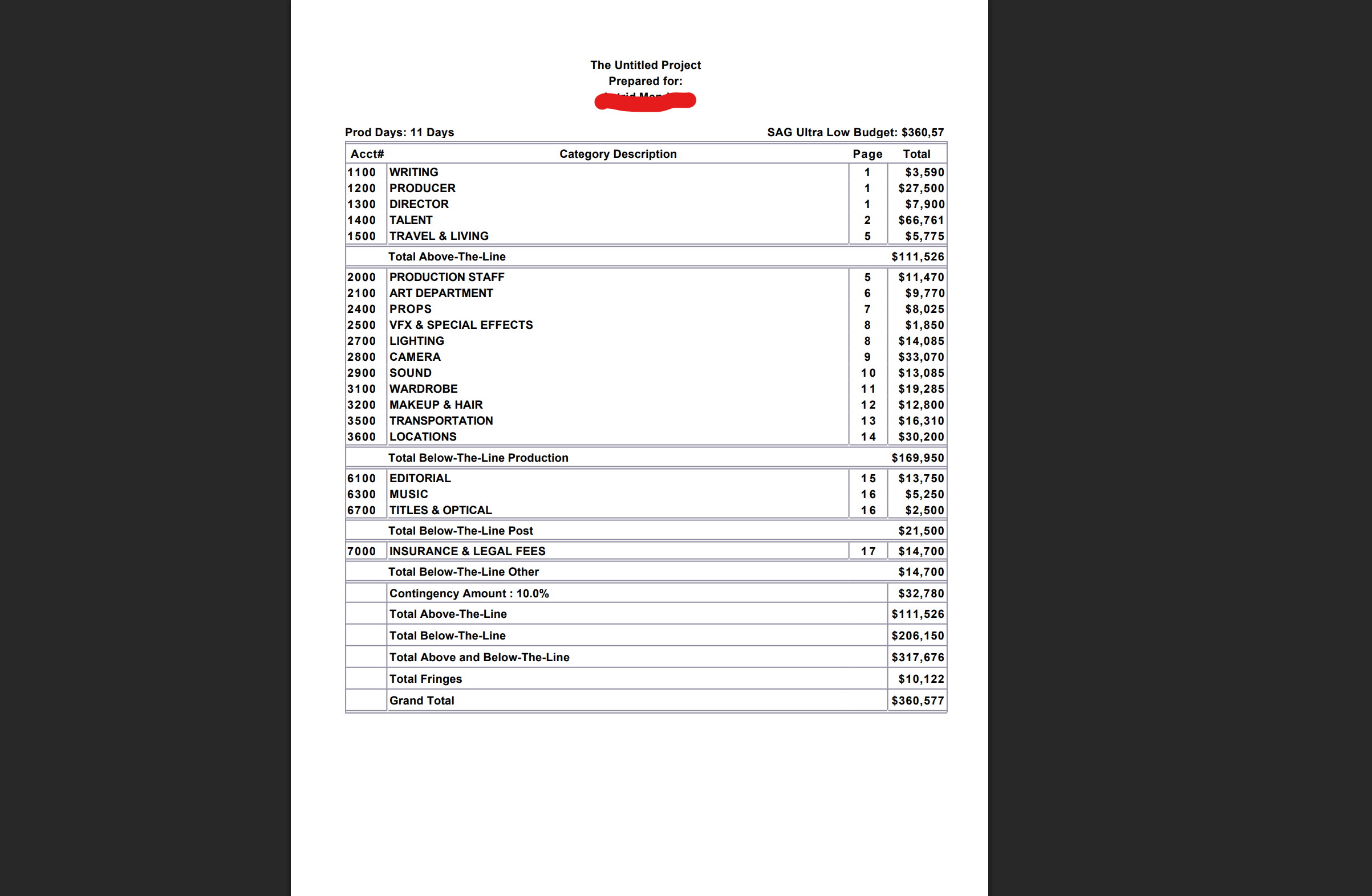
Step 17: Roll the Detail Into the Film Budget Top Sheet
Once the detailed accounts are built, the top sheet should become a summary of the underlying budget, not a separate set of numbers.
Review major sections, fringes, insurance, post, general expenses, contingency and grand total. Then compare the total against the production plan and financing assumptions.
Step 18: Stress-Test the Budget Before You Call It Final
A professional budget should survive questions, not just add up.
- What happens if the schedule grows by two shooting days?
- What happens if a key actor is available only on specific dates?
- What happens if the primary location is replaced?
- What happens if overtime is consistently higher than assumed?
- What happens if the exchange rate moves?
- What happens if the VFX count increases?
- What happens if a tax incentive is delayed or certain costs fail to qualify?
- What happens if the production moves from non-union to a union agreement?
This is where formula-driven budgets earn their value. A model that can absorb assumption changes is much safer than one made of hard-coded totals.
A Real Detailed Film Budget Example
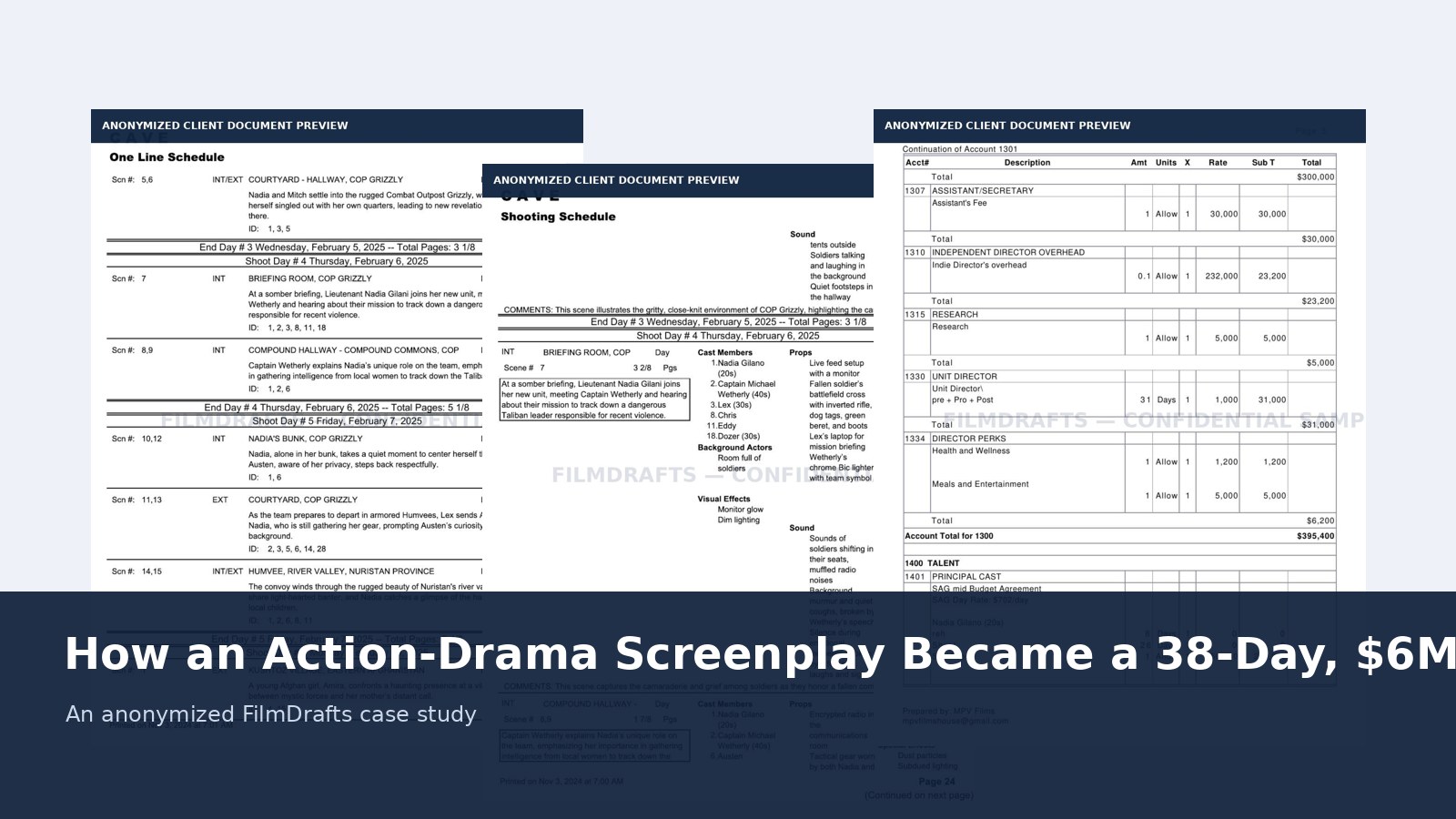
FilmDrafts' action-drama feature case study shows the same workflow at a much larger scale. The project required a screenplay breakdown, 38-day shooting schedule, detailed Movie Magic budget and business-plan work for a production plan of roughly $6 million.
The point is not the $6 million number. The point is that the budget was built from production logic. Whether the project is a $360,000 pilot or a multi-million-dollar feature, the workflow stays recognizable: break down the script, schedule it, define assumptions, price the plan and review the result.
Want to Build It Yourself? Use the FilmDrafts Pro Film Budget Template
If you understand the production assumptions and want to build the budget yourself, you do not need to start with a blank spreadsheet.
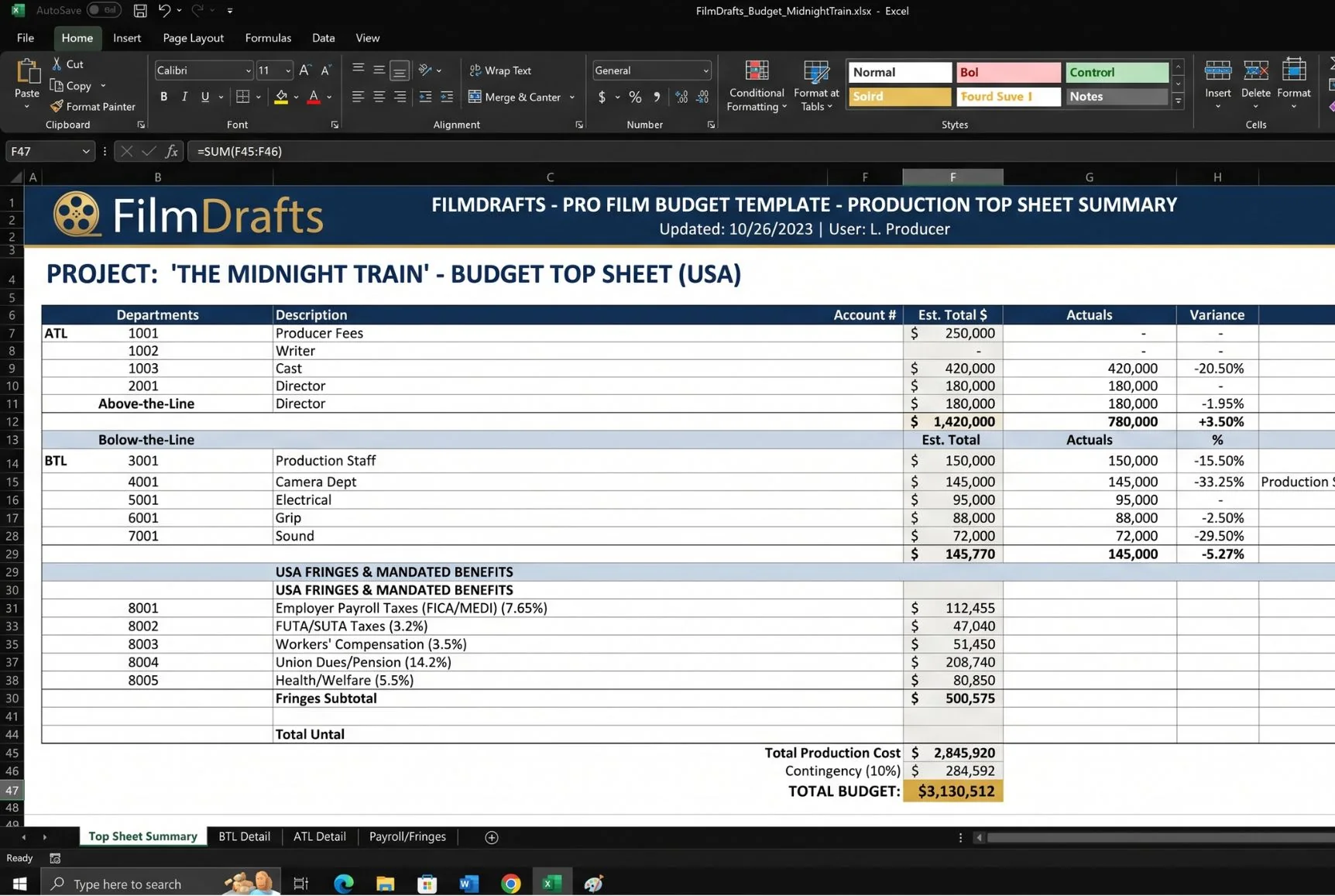
Pro Film Budget Template
The FilmDrafts film budget template is a formula-driven Excel workbook built for detailed production budgeting. It includes account detail, editable assumptions, fringe calculations and multi-currency support so rate, payroll, currency and production assumptions can flow through the workbook instead of being manually recalculated cell by cell.
Current product price: $90. The template does not replace production judgment. It removes unnecessary spreadsheet work so you can focus on the assumptions that actually determine the budget.
Purchase the Pro Film Budget Template →A professional film budget template should not be a static PDF. It should help you revise rates, fringes, currencies and quantities without rebuilding the document every time the production changes.
Movie Magic, Excel or Other Film Budgeting Software?
Movie Magic Budgeting remains a common professional tool because it is structured for production accounts, globals, fringes and reporting. Excel is more flexible and can be excellent when the workbook is designed properly. Other production tools can also support parts of the breakdown and scheduling workflow.
The software does not decide whether the schedule is realistic, whether the fringe base is correct, whether a tax-credit assumption qualifies or whether the crew structure makes sense. That is still production judgment.
For a deeper comparison, read Film Budgeting Software: Movie Magic vs Excel.
Common Mistakes When Making a Detailed Film Budget
- Starting with the target total. Forcing accounts to fit a hoped-for number hides the real production cost.
- Budgeting before scheduling. You lose the quantities that drive cast, crew, rentals and locations.
- Using only shoot-day crew rates. Prep, wrap and overtime disappear.
- Using one fringe percentage everywhere. Different groups can have different burdens and bases.
- Treating non-union labor as fringe-free. Payroll taxes, workers' comp and statutory obligations may still apply.
- Using the advertised tax-credit percentage on the whole budget. Incentives apply to qualified spend under program rules.
- Budgeting equipment for principal photography only. Prep, pickup, tests, return and weekly rental terms matter.
- Using contingency to hide omissions. Known costs belong in the accounts.
- Hard-coding currencies and rates. Revisions become slow and error-prone.
- Failing to version assumptions. If nobody knows which script, schedule or rate basis the budget uses, review becomes unreliable.
When Should You Hire a Professional Film Budget Service?
Building the budget yourself can make sense for learning, a very small short, an early estimate, or a producer who already has line-producing experience.
Professional help becomes more valuable when the budget will be used for investors, financing, talent negotiations, union signatory work, tax-credit planning, international production, multi-location shoots, series planning or meaningful production commitments.
FilmDrafts offers professional film budgeting starting at $395+ for a breakdown, schedule and detailed film budget. The goal is not to make the spreadsheet for you while ignoring the production. The goal is to translate the screenplay into a plan that can actually be reviewed.
Related FilmDrafts Guides
Frequently Asked Questions
How do you make a detailed film budget?
Start with the screenplay, complete a scene-by-scene breakdown, build a shooting schedule, document the production assumptions, then price the detailed accounts using current rates, fringes, insurance, travel, post-production, incentives and contingency. Finish by rolling the accounts into a top sheet and stress-testing the assumptions.
What does a detailed film budget include?
A detailed film budget usually includes rights and above-the-line costs, cast, crew, equipment, locations, art department, wardrobe, hair and makeup, transport, travel, post-production, payroll fringes, insurance, legal, accounting, general expenses, contingency and any project-specific costs. The exact structure varies by production.
What is the difference between a film budget top sheet and a detailed budget?
The top sheet summarizes the major account groups. The detailed budget shows the line items, quantities, rates, fringes and assumptions underneath those totals.
Do you need a shooting schedule before creating a film budget?
For a serious detailed budget, yes. You can make a rough estimate without a schedule, but the schedule determines many of the quantities that drive cast, crew, equipment, locations, travel and production operations.
How are fringes calculated in a film budget?
Fringes are additional labor costs applied to eligible wage bases. The components and rates depend on the union agreement, jurisdiction, payroll setup and employee category. Professional budgets often use separate fringe groups rather than one percentage for every worker.
How should tax credits be shown in a film budget?
Model the gross production cost first, then calculate the incentive from qualified costs under the current program rules. Keep the estimated incentive, audit or application costs, financing costs and net cost clearly separated so the producer can see both gross and net production economics.
Should I use Movie Magic or Excel for a film budget?
Both can work. Movie Magic is purpose-built for production budgeting. Excel is highly flexible and can be powerful when the workbook is formula-driven and properly structured. The best tool is the one that supports accurate assumptions, revisions and the deliverables your production needs.
Have a Screenplay and Need the Detailed Budget Built?
FilmDrafts can turn the screenplay into a script breakdown, shooting schedule and detailed production budget, with the labor, fringe, insurance, currency and incentive assumptions documented for review.
Discuss Your Project →