Producers usually ask this question at two moments: when they are deciding whether a project is realistic, and when an investor asks what the film will cost. In both cases a borrowed "average" is risky. This guide shows what drives independent film costs, what real budget structures look like, and how to arrive at a number you can defend.
Why an "Average Movie Budget" Does Not Help You
Average budget figures you find online are usually skewed by studio releases, which are far larger than independent productions. They also mix different things: some figures include marketing and distribution, some only cover production, and many are estimates rather than audited costs. Two independent films with the same running time can differ in cost by a factor of ten because one shoots in a single location over twelve days and the other needs stunts, night exteriors and a large cast across several weeks.
A useful comparison has to match your format, genre, shooting territory, union status and production approach. Even then, it can only tell you whether your estimate is in a plausible range. It cannot replace a budget built from your script.
Real Budget Examples From FilmDrafts Planning Work
The table below uses approximate planning totals from published FilmDrafts case studies. Client details are anonymized, and each total reflects the assumptions available at that stage of the project. These are examples of how scope drives cost, not price guides.
| Project | Format and scope | Schedule | Approximate planning total |
|---|---|---|---|
| Drama pilot | 50-page pilot; script breakdown, preliminary schedule and Movie Magic budget | 11 preliminary shooting days | About $360,000 |
| Crime-drama series | Eight one-hour episodes; detailed investor-draft budget and pitch deck | 105 scheduled production days | About $2.3 million (investor draft) |
| Action-drama feature | International feature; scene breakdown, schedule, detailed budget and business plan | 38 principal-photography days | About $6 million |
| International feature | Business plan, financial model and recoupment waterfall | Not published | About $10 million production scope |
The pattern is consistent: the schedule and the scale of each shooting day explain most of the difference. The pilot and the action feature are not separated by page count alone. They are separated by shooting days, cast, locations, action requirements and the size of the crew each day demands.
Where the Money Goes in an Independent Film Budget
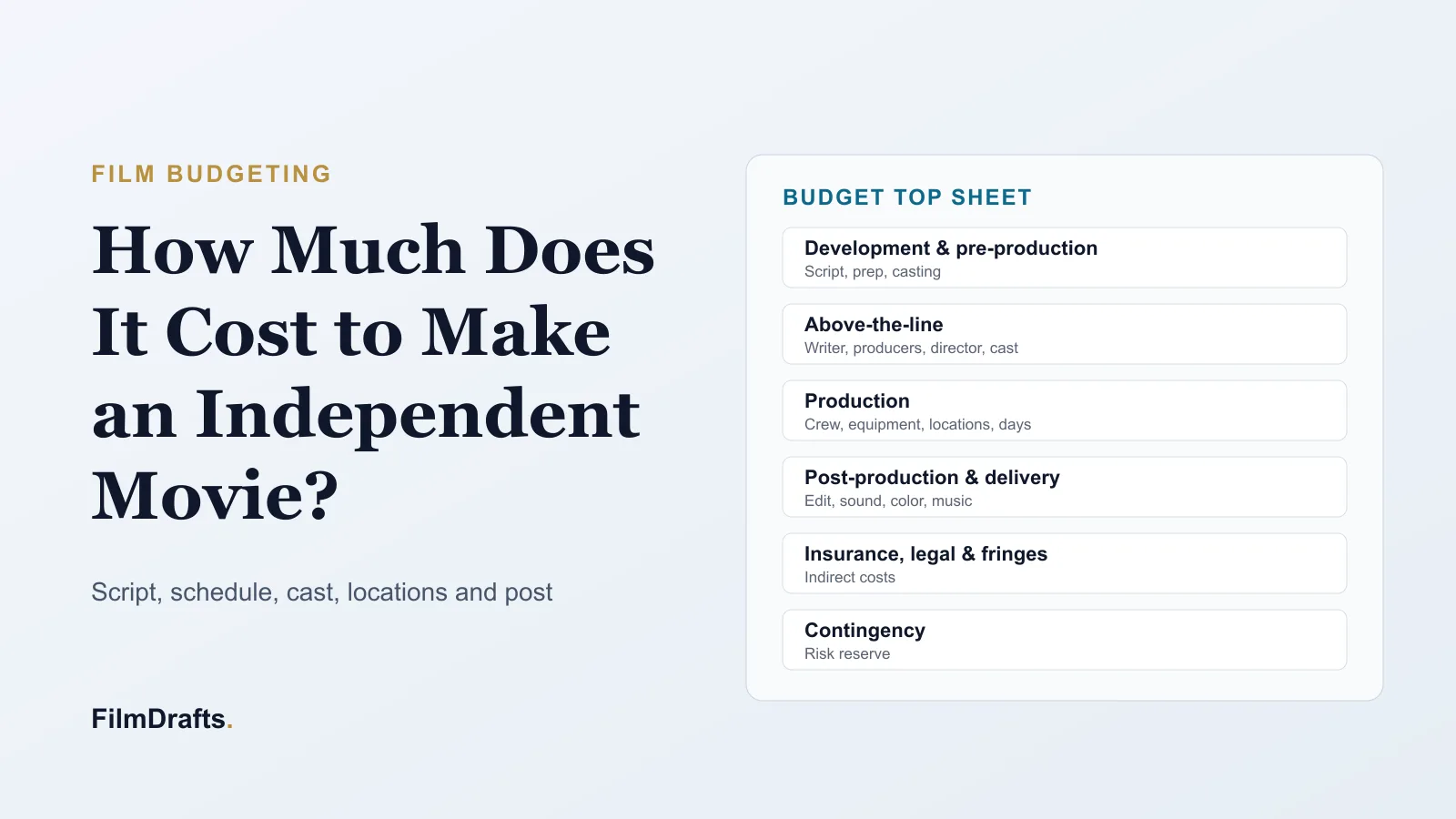
A film budget rolls detailed accounts up into a top sheet. The major groups are usually above-the-line (rights, writer, producers, director, principal cast), below-the-line production (crew, equipment, locations, transport, art, wardrobe, catering), post-production, and other costs such as insurance, legal, payroll fees and contingency.
Our low-budget film budget template guide uses an illustrative $250,000 independent feature to show how those groups can relate. It is a teaching example, not a recommended split:
| Budget group (illustration only) | Amount | What it typically covers |
|---|---|---|
| Development and pre-production | $18,000 | Script costs, prep staff, casting, scouting, early legal |
| Above-the-line | $42,000 | Writer, producers, director and principal cast |
| Production crew, equipment, locations, transport and operations | $112,000 | The shooting period: crew payroll, rentals, locations, vehicles, catering |
| Post-production, music and delivery | $48,000 | Editing, sound, color, music, deliverables |
| Insurance, legal, payroll burdens and other indirect costs | $18,000 | Production insurance, legal work, fringes and payroll fees not carried in other lines |
| Contingency | $12,000 | Reserve for risk the plan cannot remove |
Notice how much of the total sits in the shooting period. That is why the schedule is the strongest lever on cost, and why the above-the-line vs below-the-line split behaves differently from project to project.
The Cost Drivers That Matter Most
1. Number of shooting days
Every shooting day carries crew payroll, equipment rental, locations, vehicles, catering and insurance exposure. A script that needs 30 days instead of 20 does not cost a little more; it adds roughly 50 percent to most day-driven production costs. Reducing days usually comes from smarter scheduling, fewer locations and fewer company moves, not from cutting rates.
2. Cast and union status
Who you cast, how many days each performer works, and whether the production is union or non-union all change cost. For US productions using SAG-AFTRA performers, the applicable low-budget agreement depends on the film's total budget, and each agreement carries its own rates and fringe obligations. Our SAG-AFTRA low-budget agreements guide explains how this flows into the budget. Always confirm current terms with SAG-AFTRA before you lock numbers.
3. Locations and company moves
Each location adds permits, fees, parking, security and travel time. Each company move during a day costs shooting time, which can push the schedule longer. A script set largely in one or two controlled locations is cheaper to shoot than one that moves across a city every day.
4. Production complexity
Stunts, effects, weapons, animals, minors, water work, vehicles, crowds and night exteriors bring additional departments, specialists, safety requirements and insurance. Period settings add art department, wardrobe and location control costs. These requirements are visible in a careful script breakdown long before the budget is written.
5. Crew size and rates
A lean crew can work for a contained story, but larger setups need more people in camera, grip, electric, art and production. Rates depend on territory, union status and experience. Overtime and turnaround rules can change the real cost of each day.
6. Post-production and delivery
Editing, sound design and mix, color, music licensing, visual effects, titles, captions and distributor deliverables are easy to underestimate in early numbers. A film is not finished when shooting ends; it is finished when it can be delivered.
7. Insurance, legal, fringes and contingency
Production insurance, legal work, payroll taxes and fees, and a contingency reserve are real costs. Leaving them out makes an early estimate look attractive and then fail under review by investors or a completion guarantor.
Budget vs Cash Flow: When the Money Is Needed
The budget tells you the total cost. It does not tell you when each dollar must be available. Deposits, prep payroll, the shooting period and post-production all fall in different weeks. Our film production cash flow guide walks through a fictional $2.4 million feature to show how spending builds over the production timeline. Investors and lenders often ask for both documents.
How to Estimate What Your Movie Will Cost
- Break down the screenplay. List every scene's cast, locations, props, wardrobe, vehicles, effects and special requirements.
- Build a shooting schedule. Group scenes by location, cast availability and day or night to arrive at a realistic number of shooting days. See how to create a film production schedule.
- Write down your assumptions. Shooting territory, union or non-union status, crew size, equipment approach, post-production plan and delivery requirements.
- Price the accounts from the schedule. Crew weeks, cast days, rentals and locations should come from the schedule, not from a percentage of a target total.
- Roll up to a top sheet and add contingency. Review the totals by group and test what happens if the schedule grows by a few days.
- Review it with someone who will challenge it. A line producer, an experienced producer or a budgeting specialist will catch missing accounts and unrealistic rates.
For the full process, read how to make a detailed film budget step by step.
Common Mistakes in Early Cost Estimates
- Starting from a target number and working backward instead of starting from the script.
- Budgeting fewer shooting days than the schedule actually supports.
- Leaving out fringes, payroll fees, insurance, legal or contingency.
- Underestimating post-production, music and delivery.
- Copying another film's category percentages without checking whether the projects are comparable.
- Treating a development estimate as a production-ready budget.
When to Get a Professional Film Budget
A rough estimate is fine for testing an idea. Once you are approaching investors, applying for incentives, hiring key crew or preparing a financing plan, you need a budget whose assumptions can be explained line by line. FilmDrafts builds screenplay-based budgets in Movie Magic Budgeting or Excel, connected to a script breakdown and shooting schedule. See the detailed film budget service for deliverables, turnaround and starting rates, or review who makes a film budget if you are still deciding between DIY, a line producer and a budgeting service.
Related FilmDrafts Guides
Frequently Asked Questions
How much does it cost to make a low-budget independent movie?
It depends on the script and the production approach. A contained story with few locations and a short schedule costs far less than one with action, period settings or a large cast. The illustrative $250,000 feature in our template guide shows one possible structure, but your own breakdown and schedule are the only reliable basis.
Does a film budget include marketing and distribution?
A production budget normally covers development through delivery of the finished film. Marketing and distribution spending is usually planned and funded separately, often by the distributor, so make clear which figure you are presenting.
Why do two films of the same length cost such different amounts?
Page count is a weak predictor. Shooting days, locations, cast, union terms, action, effects and post-production requirements explain most of the difference.
How accurate is an early cost estimate?
An early estimate is a feasibility check. It becomes reliable only after the script is broken down, the schedule is built and each account is priced from those assumptions.
What do I need to get a budget prepared?
A current screenplay, your target budget range if you have one, the intended shooting location, union status, and any known casting, schedule or delivery requirements.
Find Out What Your Film Will Actually Cost
Send FilmDrafts your screenplay and production assumptions. We prepare the script breakdown, shooting schedule and a detailed production budget you can review with investors and key crew.
View Film Budget Service →