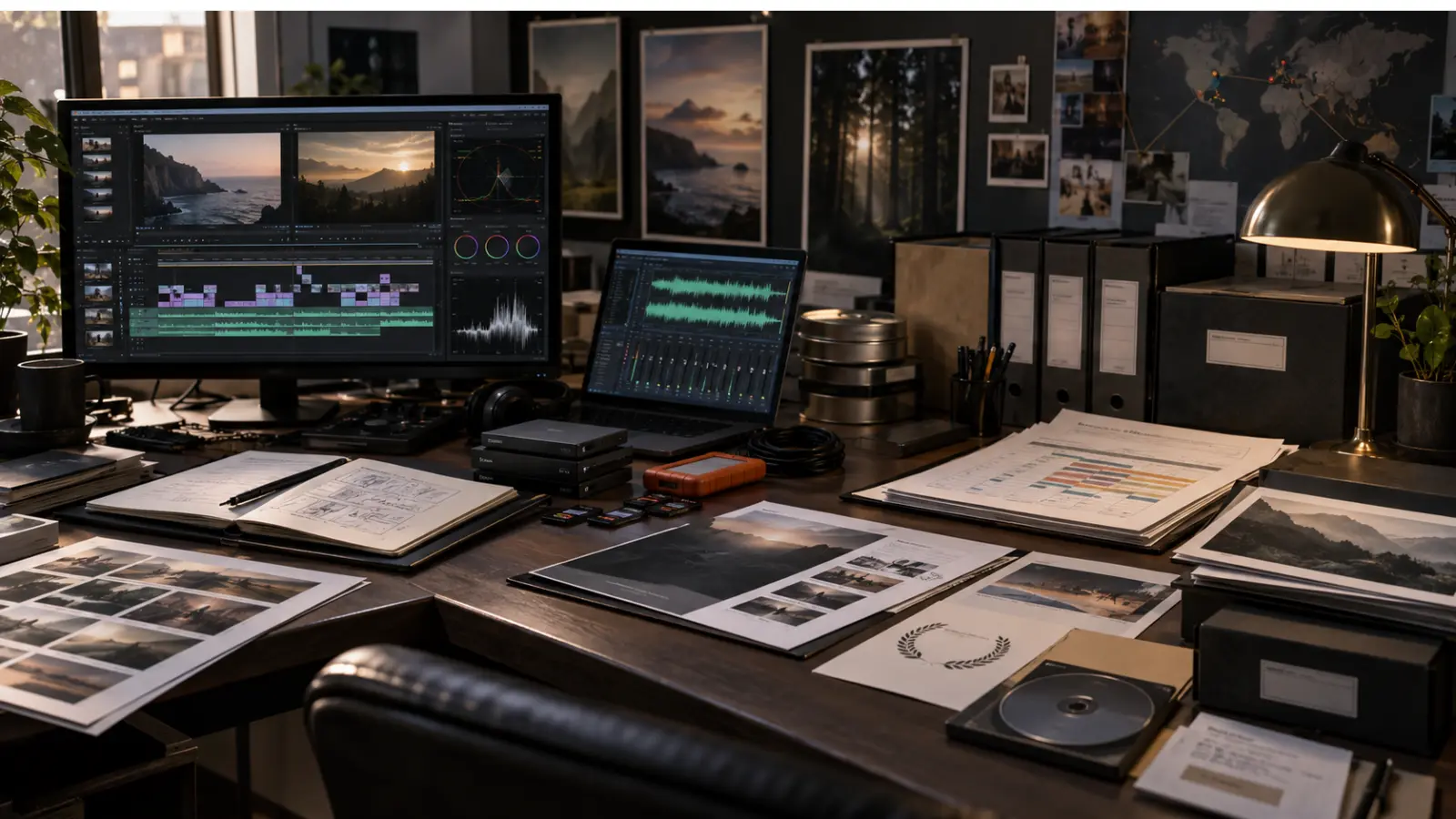
The film production process is often summarized in three broad phases—pre-production, production and post-production—but real projects usually move through a wider seven-stage workflow. Looking at the stages in more detail is helpful because each phase has different goals, documents, risks, deliverables and decision-makers. If you understand where development ends and pre-production begins, or how post-production connects to sales and distribution, you make better decisions about budgets, schedules and staffing.
The seven-stage model is also more useful for independent filmmakers than a vague “from script to screen” description. It shows when the screenplay becomes a practical plan, when financing and packaging matter most, when principal photography actually starts, and why distribution is not something you leave until the movie is already finished.
The 7 Stages of Film Production at a Glance
Different producers group the film production lifecycle slightly differently, but the workflow below closely matches how most independent narrative projects move from idea to release.
| Stage | Main goal | Typical outputs |
|---|---|---|
| 1. Development | Turn an idea into a viable project. | Rights, logline, treatment, screenplay drafts, early creative package, rough feasibility. |
| 2. Financing & Packaging | Build the package and funding path. | Budget range, schedule assumptions, cast/director attachments, investor or lender materials, finance plan. |
| 3. Pre-production | Prepare the project to shoot. | Script breakdown, shooting schedule, budget, hires, locations, permits, insurance, prep documents. |
| 4. Production | Capture the footage and production sound. | Daily call sheets, camera reports, dailies, continuity notes, production actuals. |
| 5. Post-production | Turn raw footage into a finished film. | Picture edit, sound design, ADR, music, VFX, color, masters and QC versions. |
| 6. Marketing & Sales | Position the film for buyers and audiences. | Poster/key art, trailer, synopsis, festival strategy, publicity assets, sales outreach. |
| 7. Distribution & Delivery | Get the final film to platforms and viewers. | Delivery package, captions, legal clearances, platform files, release plan and launch execution. |
Notice that this structure still contains the familiar three-phase model. Pre-production, production and post-production remain the core physical phases, but development, financing, marketing and distribution have to be considered too if you want a full picture of how movies actually get made and released.
Stage 1: Development
Development is where the project is born and shaped. This phase can start with an original idea, a book or article option, a true story, an existing screenplay, or a commissioned concept from a production company. The goal is not simply to “write a script.” The goal is to decide whether the project is worth continuing and what form it should take.
During development, writers and producers work on concept, theme, tone, character and structure. The material may go through multiple drafts, and the project may be tested against practical questions such as target audience, likely budget scale, rights chain, market comparables and intended format. A contained one-location thriller and a multi-country period piece may both be good stories, but they imply very different production demands.
What usually happens in development?
- securing or clarifying underlying rights;
- writing a logline, treatment and screenplay drafts;
- deciding whether the project is a short, feature, pilot or series;
- early producer notes, rewrites and creative packaging conversations;
- rough budgeting and feasibility checks;
- initial market positioning and audience thinking.
This is also the stage where many producers first ask, “Is this a $100,000 film or a $5 million film?” A rough answer is enough at first, but eventually development has to connect to more detailed planning.
Stage 2: Financing & Packaging
Once the project is strong enough creatively, producers usually move into packaging and financing. Some projects do this formally after development; others overlap the two stages. Packaging means assembling the elements that help the project attract money and partners. That could include a director, cast attachments, lookbook, teaser, business plan, top-level budget range and schedule assumptions.
Financing is the part where the producer identifies how the movie might actually be paid for. Depending on the project, this can involve private equity, grants, presales, gap financing, tax incentives, soft money, production-company financing or a combination of several sources.
In practical terms, stage two is where the project becomes easier to discuss with outside stakeholders. You are no longer presenting “just a script.” You are presenting a film with a scale, a plan and a path to execution.
Key outputs of financing and packaging
- a defendable budget range and schedule range;
- investor-facing or partner-facing materials;
- comparable titles and positioning logic;
- director and cast attachment strategy;
- clear assumptions about shooting region, incentives and target production scale.
If you are building investor materials, our investor package service and film business plan service sit in this part of the workflow.
Stage 3: Pre-production
Pre-production is the stage most people think of when they say “film production planning.” This is where the screenplay is translated into the real-world decisions needed to shoot it. If development is about story potential, pre-production is about execution.
During pre-production, the team breaks down the script scene by scene, identifies every production element, builds the shooting schedule, refines the budget, hires key crew, scouts locations, finalizes casting, organizes gear and vendors, and resolves the countless logistical questions that make or break a shoot.
For independent producers, this is often the stage where the project either becomes solid or falls apart. A script may read well and still be difficult to shoot economically if the schedule is inefficient, locations are scattered or the department workload is underestimated.
What happens in pre-production?
- script breakdown by scene and production element;
- stripboard and shooting-schedule creation;
- budget refinement and contingency planning;
- location scouting, permits and insurance planning;
- crew hiring and department prep;
- casting, rehearsals and tech scouts;
- equipment/vendor booking and travel planning;
- production paperwork such as call-sheet templates, releases and prep calendars.
This is the stage where FilmDrafts most directly helps producers. Our script breakdown & scheduling service and detailed film budget service are designed to support the transition from screenplay to practical production plan.

If you want a deeper dive into the planning side of prep, see our guides on film pre-production costs, how script breakdown affects schedule and budget and a low-budget shooting schedule example.
Stage 4: Production
Production is the shooting phase—also called principal photography. This is the stage where the script is finally performed and captured. Because production days are expensive, the work done in pre-production is supposed to make this stage faster, safer and more predictable.
During production, the team works from a daily schedule and call sheet. The director focuses on performance and coverage, the cinematography team captures the footage, assistant directors manage the day, the line producer or UPM keeps the unit moving, and department heads execute the approved plan while adapting to real-world changes.
Every shoot day creates a stream of operational information: dailies, sound reports, camera reports, continuity notes, production reports, petty-cash logs, purchase orders and cost updates. This is why production is not just a creative phase. It is a live management phase where schedule pressure and budget pressure meet the reality of weather, locations, actor availability and time.
What matters most in production?
- staying on schedule without sacrificing essential coverage;
- capturing clean sound and technically usable footage;
- managing overtime, company moves and contingency triggers;
- keeping communication between departments tight;
- tracking actual spending against the plan.
Many first-time filmmakers assume the shoot is the “main part” of production. In reality, production is only one stage in a much longer process, and it works well only when the surrounding stages are disciplined.
Stage 5: Post-production
Post-production begins once footage starts coming in, though in practice some work overlaps with production. Editors may begin assembling scenes while the shoot is still happening. After photography wraps, the film moves into the stage where raw materials become a finished viewing experience.
Picture editing shapes pace, clarity and emotional rhythm. Sound editorial cleans production sound, adds design and ambience, and prepares ADR or Foley where needed. Music may be commissioned, licensed or temped before the final score is locked. If the project requires visual effects, those shots move through their own pipeline. Finally, the film is color corrected, mixed, mastered and quality-checked.
What happens in post-production?
- assembly cut, editor's cut and revised picture edits;
- sound editorial, dialogue cleanup, Foley and ADR;
- music composition, licensing or supervision;
- VFX, titles, graphics and subtitles/captions;
- color correction, online finishing and final mix;
- master exports and technical QC.
Post-production is often underestimated because the shoot feels more visible. But for many projects, the story truly finds its final form here.
Stage 6: Marketing & Sales
Marketing and sales are frequently treated as afterthoughts, yet they strongly influence whether the finished film gets seen. This stage is about preparing the materials and strategy needed to position the project for festivals, buyers, distributors, platforms or a direct-to-audience release.
Depending on the project, this can include a trailer, poster or key art, stills selection, synopsis refinement, press notes, social content, electronic press kit (EPK), audience targeting, festival submissions and outreach to sales agents or distributors. Even if a third party later handles distribution, good marketing prep improves the project's chances.
On some independent productions, this stage starts much earlier than expected. Producers may begin building the audience story while the film is still in post, because festival deadlines, sales markets and release windows are time-sensitive.
Stage 7: Distribution & Delivery
The final stage is getting the movie delivered and released. Distribution does not just mean uploading a file somewhere. It usually involves technical deliverables, legal deliverables and a release strategy.
Technical delivery requirements vary by platform and territory, but they may include picture masters, audio stems, captions, subtitles, artwork, metadata, QC reports and various file formats. Legal delivery can involve music licenses, chain-of-title documents, E&O insurance, cast agreements and cue sheets. Without proper delivery materials, a finished film may still be impossible to release smoothly.
Distribution can be theatrical, educational, transactional VOD, subscription streaming, ad-supported streaming, airline, broadcast or a hybrid of several routes. The right path depends on the type of film, the audience, the territory strategy and the project's business goals.

Film Production Stages vs Pre-Production, Production and Post-Production
Google suggestions show that many people search for pre production, production and post production as if those are the only stages. That three-phase model is not wrong—it is just incomplete.
If you are explaining the process quickly, the three-phase view is fine. If you are budgeting, packaging, staffing or planning release timing, the seven-stage model is more useful.
How Long Does Film Production Take?
There is no universal timeline, but the length of each stage varies based on scope, format, budget and complexity. Short films can move very quickly. Features and series often take months or even years when development, financing, post and release planning are included.
| Project type | Development & packaging | Pre-production | Production | Post-production |
|---|---|---|---|---|
| Short film | 2–12 weeks | 1–4 weeks | 1–5 days | 2–8 weeks |
| Micro/low-budget feature | 2–8 months | 4–10 weeks | 12–25 days | 2–5 months |
| Independent feature | 6–18 months | 6–12 weeks | 15–40 days | 3–8 months |
| Larger feature or series | Highly variable | 2–6+ months | Weeks to months | Months to more than a year |
The important point is that the shoot itself is usually only a fraction of the total timeline. Development, financing and post often consume more calendar time than production days alone.
Why the Stages Often Overlap
The seven stages are helpful, but real projects are not perfectly linear. Packaging can start during development. Editors may begin during production. Marketing assets may be developed while the cut is still changing. Delivery planning can start before final color and mix are complete.
This overlap is normal. The purpose of the stage framework is not to force an unrealistic straight line. The purpose is to clarify what work belongs to which part of the process and what has to be ready before the next major step is safe or efficient.
Where FilmDrafts Fits in the Workflow
FilmDrafts works most directly across financing & packaging and pre-production. That is where professional planning documents help a producer move from idea to actionable production.
- Script Breakdown & Scheduling helps when the screenplay needs to become a scene-by-scene production plan.
- Detailed Film Budget Service helps when you need a project-specific budget tied to practical assumptions.
- Investor Package and Film Business Plan help when the project needs financing-facing materials.
Related FilmDrafts Guides
Frequently Asked Questions
What are the stages of film production?
The complete workflow is commonly described as development, financing & packaging, pre-production, production, post-production, marketing & sales, and distribution & delivery.
What are the 7 stages of film production?
A practical seven-stage model is: development, financing & packaging, pre-production, production, post-production, marketing & sales, and distribution & delivery.
What is the difference between film production stages and the three phases?
The three phases are pre-production, production and post-production. The seven-stage model adds development, financing, marketing and distribution so the entire lifecycle is visible.
What happens in pre-production?
Pre-production typically includes script breakdown, shooting schedule, budget development, key crew hiring, casting, location scouting, permits, insurance, vendor planning and prep paperwork.
What happens in post-production?
Post-production usually includes editing, sound design, ADR, music, VFX, color correction, online finishing, captions/subtitles, mastering and quality control.
How long does film production take?
The total timeline varies widely. A short film may move from prep to completion in weeks, while a feature may spend months in development, several weeks in prep and production, and additional months in post-production and release planning.
What happens during development?
Development is where the concept, rights and screenplay are shaped into a viable project. It often includes rewrites, early feasibility checks and initial package discussions.
What is packaging in film?
Packaging means assembling key creative and business elements—such as a director, cast interest, budget range, schedule assumptions and financing materials—to make the project easier to finance or greenlight.
When does distribution start?
Formally, distribution starts after the project has a finished deliverable and release plan. In practice, many producers begin thinking about festivals, buyers, audience targeting and marketing materials well before post-production is complete.
Do all films follow all seven stages?
Almost all projects touch each of these functions, but smaller productions may combine or compress them. For example, a short film may have minimal packaging and a very simple distribution plan.
Which stage costs the most?
For many narrative films, production is the most expensive phase because payroll, equipment, locations and daily logistics accumulate quickly. However, long development or VFX-heavy post-production can also be major cost drivers.
When should the budget and shooting schedule be created?
A rough budget can appear in development, but the detailed budget and shooting schedule are usually built in pre-production after the script is broken down scene by scene.
Who manages each stage?
Responsibilities vary by project, but producers oversee the whole process, writers and producers lead development, line producers/UPMs and assistant directors shape prep and production logistics, and editors/post supervisors lead major parts of post-production.
What deliverables are needed for distribution?
That depends on the platform, but common deliverables include picture masters, audio files or stems, captions, subtitles, poster art, stills, metadata, cue sheets, licenses and legal documentation.
Where can I get help with breakdown, scheduling and budgeting?
If you already have a screenplay and need the planning documents that sit between development and production, FilmDrafts can help with script breakdown, scheduling and detailed budgeting services.
Need Help Turning a Script Into a Production Plan?
If you are moving from development into prep, FilmDrafts can help with script breakdown, scheduling, budgeting and investor-facing planning documents.
Explore FilmDrafts Services →